

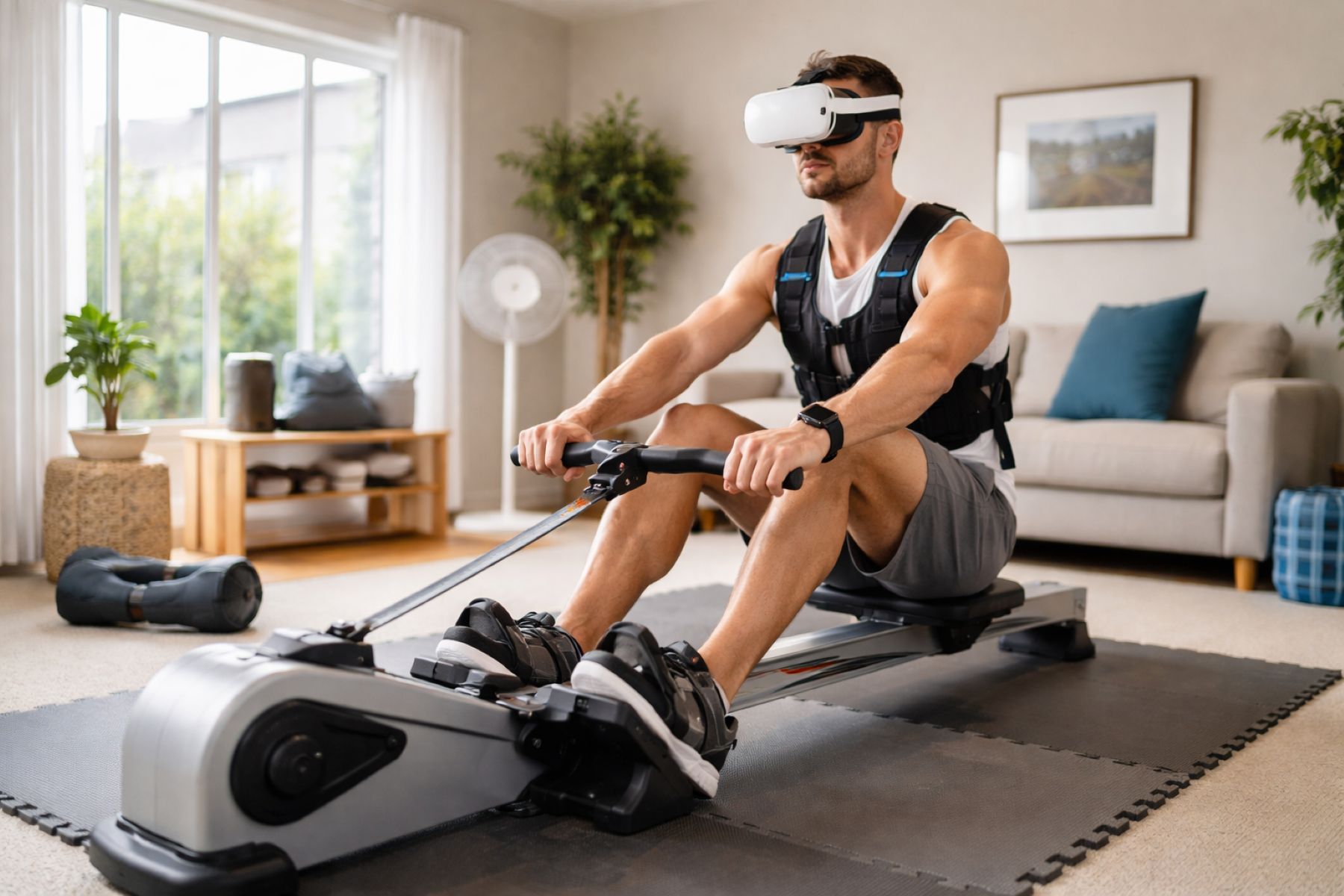
Imagine waking up and, instead of dreading the repetitive thud of a treadmill, you find yourself standing on the edge of a crystal-clear lake in the Swiss Alps or inside a neon-drenched synthwave dreamscape. You aren’t just “working out”; you’re embarking on a mission. This is the reality of fitness in 2026. Designing an immersive low-impact VR fitness routine has become the ultimate “cheat code” for those of us who want the high-calorie burn of a marathon without the soul-crushing joint pain that often follows.
The beauty of virtual reality is its ability to trick the brain. When you’re busy slicing through glowing orbs or rowing through a prehistoric jungle, your “perceived exertion” drops significantly. Research from late 2025 has shown that VR users often exercise longer and at higher intensities than those on traditional equipment, simply because they are having too much fun to notice the sweat. If you’ve been looking for a way to stay consistent without destroying your knees, the 2026 generation of mixed-reality gear is your new best friend.
The Evolution of the Virtual Gym: 2026 Gear Guide
To build a truly immersive VR fitness routine, you need hardware that disappears once you put it on. We’ve moved past the days of clunky, front-heavy headsets that leave “VR face” for hours. The current gold standard for standalone fitness is the Meta Quest 3S and its more powerful sibling, the Quest 3. Thanks to the Snapdragon XR2 Gen 2 processor, these devices offer “color passthrough” that is so crisp it feels like you’re wearing clear glasses. This is a game-changer for low-impact routines because it allows for “Mixed Reality” (MR) workouts—where your digital trainer stands in your actual living room, ensuring you don’t accidentally punch your ceiling fan or trip over the cat.
If you’re a stickler for ergonomics and visuals, the Pico 4 Ultra has carved out a massive niche in the fitness world. Its balanced battery design (situated at the back of the head) makes it feel weightless during long, steady-state cardio sessions. But the gear doesn’t stop at the headset. To keep your tech from becoming a salty mess, you absolutely need a silicone face cover and a high-quality sweatband. In 2026, many enthusiasts are also pairing their headsets with the Whoop 5.0 or Oura Ring 4, which sync directly to your VR HUD to show your real-time heart rate and “heat strain” index as you move.
Crafting the Low-Impact Experience: Content for Your VR Fitness Routine
A sustainable VR fitness routine isn’t just about playing one game until you’re bored; it’s about variety. The 2026 app ecosystem is divided into three main pillars: rhythm-based movement, adventure-driven cardio, and mixed-reality strength training.
For those who crave the “flow state,” apps like Supernatural and Synth Riders are essential. Supernatural remains a heavy hitter because it uses real-world photorealistic locations and expert coaching, turning a low-impact arm workout into a majestic experience. Meanwhile, Synth Riders offers a “Force Mode” that encourages large, sweeping movements—perfect for burning calories without the jarring impact of jumping jacks. If you want something a bit more “gamified,” Pistol Whip is essentially a leg-day masquerading as an action movie. By dodging bullets and obstacles, you’re forced into deep squats and lateral lunges that build functional strength while your brain is focused on the beat.
For the “adventure seekers,” Kayak VR: Mirage and HOLOFIT provide the ultimate escape. These are perfect for what we call “Active Recovery” days. You can sync HOLOFIT with a real rowing machine or elliptical, or simply use the “Freestyle” mode to mimic the movements. There is something profoundly meditative about rowing through an Antarctic ice cave while your actual body is just burning off last night’s pizza in a suburban bedroom.
The 7-Day Immersive VR Fitness Routine Blueprint
To see real results, consistency is king. This isn’t about pushing yourself to the breaking point on Day 1; it’s about building a rhythm. Here is how a balanced, low-impact weekly plan looks in 2026:
-
Monday: Cardio Flow (Supernatural/FitXR). Start the week with a full-body mobility session. Focus on those large, sweeping arm movements and consistent heart rate elevation.
-
Tuesday: The “Neon” Recovery (Synth Riders). Keep it light. Use the music to guide your movement. This is about endurance and keeping the joints moving without stress.
-
Wednesday: Stealth Leg Day (Pistol Whip). No weights required. The constant dodging and weaving will have your quads screaming by the end of a 20-minute session, but because you’re “the hero,” you’ll barely feel it until you take the headset off.
-
Thursday: Mindful Mobility (TRIPP or Guided Meditation). VR isn’t just for sweat. Use today to focus on breathing and mental clarity. It helps with the neurological adaptation to being in virtual spaces.
-
Friday: High-Intensity Rhythm (Beat Saber/Les Mills Bodycombat). Turn up the difficulty. Focus on speed and precision. This is your “Friday Night Lights” workout.
-
Saturday: The Weekend Expedition (Kayak VR or HOLOFIT). Go for a long-form session (30–45 minutes). Pick a beautiful environment and just go. It’s steady-state cardio at its most beautiful.
-
Sunday: Rest & Recharge. Let your muscles recover. Use this time to clean your lenses and charge your controllers.
Engineering Your Environment for Maximum Immersion
You can have the best gear in the world, but if your physical space is cluttered, the immersion will break. For a successful VR fitness routine, you need a dedicated “Guardian” space of at least 6.5 x 6.5 feet. A pro-tip that has gained traction recently is using a textured yoga mat or a circular “VR mat” in the center of your room. This gives your feet a tactile “home base,” allowing you to move confidently without fearing you’ve drifted too close to your TV.
Lighting is also key. While 2026 headsets have incredible tracking, they still struggle in pitch-black rooms. Use a dim, warm light or an IR (Infrared) illuminator if you prefer working out in the dark. This keeps the tracking rock-solid while maintaining that “theatre-like” immersion. And don’t forget the airflow! A small floor fan pointed at your play area isn’t just for cooling; it acts as a “directional anchor” that helps your brain stay oriented in the real world while your eyes are in the metaverse.
The “Why” Behind the Virtual Sweat
Why are so many of us ditching the traditional gym for a headset? It comes down to the psychology of “friction.” For most people, the hardest part of working out is the commute, the crowded locker rooms, or the feeling of being judged. In VR, the gym is ten seconds away. You can be in your pajamas (or specialized sweat-wicking gear like the Lululemon Metal Vent series) and be halfway through your VR fitness routine before your brain has time to talk you out of it.
Moreover, the low-impact nature of these workouts is inclusive. Whether you’re a 22-year-old athlete looking for cross-training or someone recovering from a minor injury, VR offers a way to keep the heart rate up without the “wear and tear.” We are seeing a massive shift toward “Longevity Fitness”—the idea that we should train in a way that allows us to keep moving for the next 50 years, not just the next 50 days.