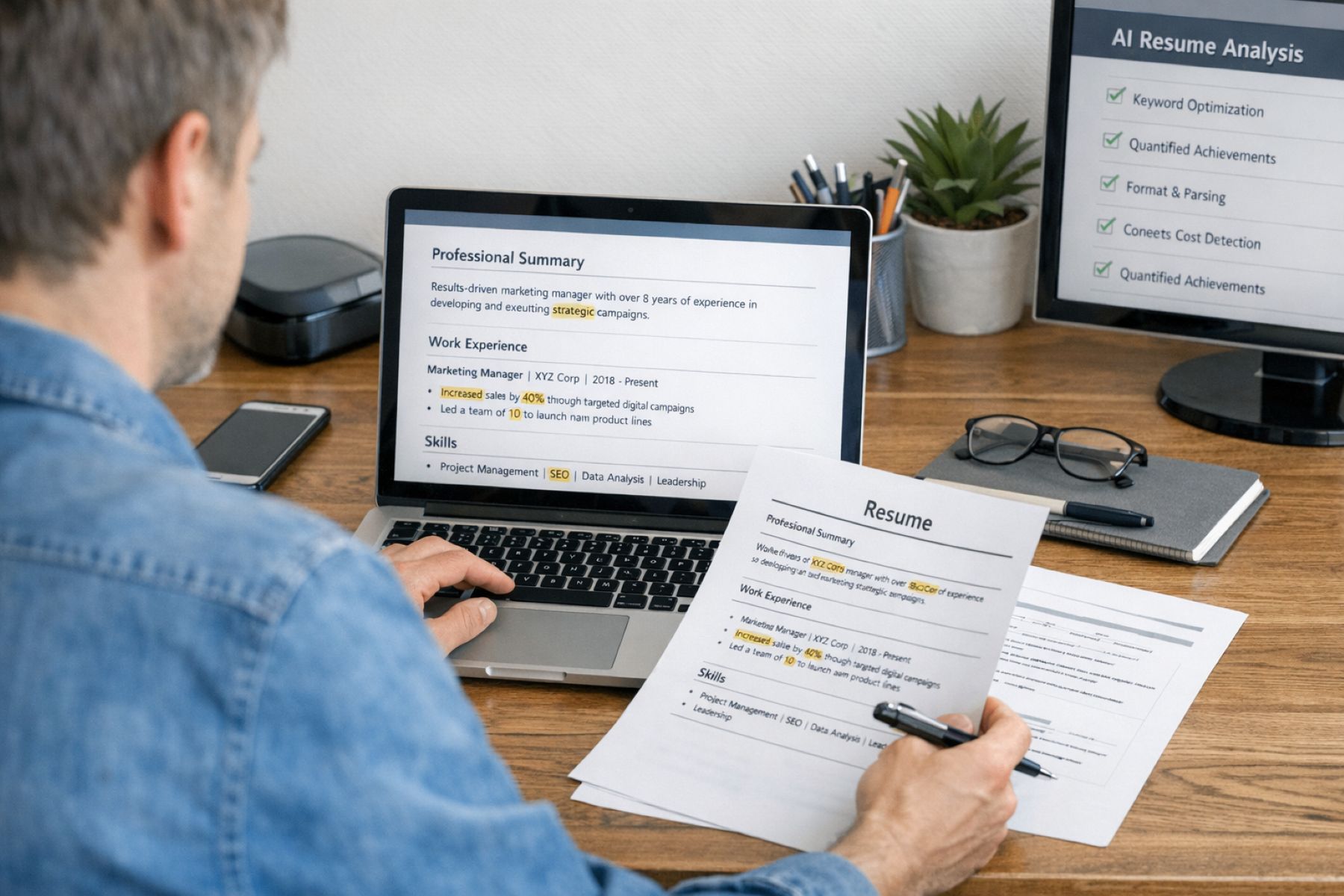
AI resume optimization is no longer a “nice-to-have” trick for tech enthusiasts; it is the fundamental barrier between your career aspirations and a recruiter’s inbox in 2026. If you’ve spent the last week meticulously adjusting the hex codes of your sidebar or hunting for a unique script font to make your name “pop,” I have some sobering news for you. The gatekeeper to your dream job isn’t a human with an eye for aesthetics—it is a sophisticated algorithm designed to parse, rank, and potentially discard your application before a human ever lays eyes on it.
The landscape of hiring has shifted from simple keyword matching to deep semantic understanding. Today, over 99% of Fortune 500 companies—and a rapidly growing percentage of mid-sized firms—employ AI-driven Applicant Tracking Systems (ATS). These platforms don’t just look for words; they look for context, intent, and historical success patterns. Understanding how to speak the language of these machines while maintaining your human soul is the most critical skill in the modern job market.
The Evolution of the Digital Gatekeeper
To master the current hiring environment, we first have to deconstruct what these systems actually are. In the early 2020s, an ATS was essentially a digital filing cabinet with a basic search function. If you typed “Project Manager” enough times, you might climb to the top. Fast forward to 2026, and the “bots” have graduated. Modern systems utilize Natural Language Processing (NLP) to understand the nuances of your professional history.
When you engage in AI resume optimization, you are essentially providing a roadmap for a Large Language Model (LLM) that has been trained on millions of successful career trajectories. These systems now perform “contextual parsing.” This means the AI understands that a “Client Success Specialist” and an “Account Management Lead” often share 90% of the same DNA. However, just because the AI is smarter doesn’t mean you can be lazier. In fact, the precision required has only increased because the AI is now looking for the “why” and the “how” behind your bullet points, not just the “what.”
Predictive analytics have also entered the chat. Many modern platforms now assign a “fit score” to candidates based on how closely their career progression mirrors that of high performers already working within the company. This means your resume needs to demonstrate a logical, data-backed trajectory that signals low risk and high potential to the algorithm.
The Architecture of an Algorithm-Friendly Resume
Before we even talk about the words on the page, we have to talk about the page itself. One of the most heartbreaking mistakes I see brilliant professionals make is over-engineering their resume design. You might think a two-column layout with a sleek progress bar for your “Photoshop skills” looks modern, but to an ATS, that document looks like a digital jigsaw puzzle with missing pieces.
The golden rule for 2026 is radical simplicity in formatting. Most AI parsers read a document from top-to-bottom and left-to-right. When you introduce columns, the parser often blends the text from the left column into the right column, creating a word salad that makes zero sense to the ranking algorithm. If the machine can’t determine which dates belong to which job, or which skills belong to which project, your fit score plummets.
Stick to a single-column layout. Avoid tables, text boxes, and graphics at all costs. While it feels boring to use standard fonts like Arial, Calibri, or Helvetica, these are the “cleanest” for an AI to read. Furthermore, keep your contact information out of the header and footer sections. Many older or even mid-tier AI systems are programmed to ignore headers and footers to save processing power, meaning the recruiter might see your great experience but have no way to call you.
Speaking “Machine” with AI Resume Optimization
Once your structure is sound, the focus shifts to the meat of the content. AI resume optimization in 2026 is about “Semantic Resonance.” This is the practice of aligning your professional narrative with the specific vocabulary and intent of the job description.
Forget the old-school “keyword stuffing” where people would hide white-colored text in the margins. Modern AI sees right through that and will likely flag your application as spam. Instead, you need to identify the core competencies the employer is seeking and weave them into your narrative naturally. If a job description emphasizes “Cross-functional Stakeholder Management,” don’t just write “managed teams.” Use the exact terminology of the posting at least once, and then support it with varied synonyms throughout the rest of the document.
A major shift in 2026 is the importance of “Impact Verbs” combined with “Quantifiable Evidence.” The AI is looking for evidence of “Success Patterns.” It wants to see that you didn’t just do things, but that you achieved things. Every bullet point should ideally follow a formula: Action Verb + Task + Result (Numeric). Instead of saying “Responsible for social media,” try “Scaled organic social media engagement by 45% over 6 months by implementing an AI-driven content strategy.” This gives the AI both the keyword (“AI-driven content strategy”) and the proof of efficacy (the 45% metric).
The Power of Job Title Alignment and Semantic Keywords
One of the subtlest yet most powerful moves in AI resume optimization is how you handle your job titles. While your internal company title might have been “Level 4 Solutions Architect,” if the rest of the industry—and the job you’re applying for—calls it a “Senior Cloud Engineer,” you are doing yourself a disservice by using the internal jargon.
The AI uses your job titles as primary anchors for your “experience level.” If the job posting is for a “Marketing Manager” and your last three titles were “Content Specialist,” “Growth Lead,” and “Creative Strategist,” the AI might struggle to see the linear progression. It is perfectly acceptable (and often necessary) to include a “Functional Title” in parentheses next to your official one if it more accurately reflects the role you performed and the role you are targeting. This helps the algorithm bridge the gap between your past and your future.
Leveraging the Tools of the Trade
You don’t have to guess whether your resume is optimized. In 2026, the same technology used to screen you is available to help you. Platforms like Jobscan have become the industry standard for a reason: they allow you to upload your resume alongside a specific job description and receive a “Match Rate” percentage. This is essentially a simulated look through the eyes of an ATS.
Other tools like Resume Worded or Teal offer real-time feedback on your brevity and impact. They can point out if your sentences are too long (which can confuse NLP models) or if you’ve used too many “cliché” words that add no value to your fit score. Kickresume and Rezi take it a step further by using generative AI to help you draft the bullet points themselves, ensuring they are packed with the right LSI (Latent Semantic Indexing) keywords that signal depth of knowledge in your field.
However, a word of caution: use these tools as a compass, not a pilot. If you let an AI write 100% of your resume, it will lack the human “spark” that a recruiter looks for once you finally pass the initial automated screen. Use the tools to perform your AI resume optimization, then read it aloud to ensure it still sounds like a person a team would actually want to grab coffee with.
The “Plain Text” Acid Test for AI Resume Optimization
If you want to be absolutely certain your AI resume optimization has worked, there is one foolproof test you can perform right now. Open your resume, press Ctrl+A (select all), and copy the entire thing. Then, open a basic text editor like Notepad or TextEdit and paste it in.
Look at the result. Is the text in a logical order? Are your dates still next to your job titles? Did the bullet points turn into weird symbols, or did they remain as clean breaks? If the text looks like a jumbled mess, that is exactly what the AI is seeing. If you can’t read it easily in Notepad, the ATS can’t rank it easily in its database. This “Plain Text Test” is the final sanity check every modern job seeker needs before hitting “Submit.”
A Final Perspective: The Human at the End of the Tunnel
It is easy to get discouraged and feel like you’re just a series of data points in a giant corporate machine. But remember: the AI is not the one who hires you. The AI is simply the one who decides if a human gets to hire you.
The goal of AI resume optimization isn’t to trick a computer; it’s to remove the friction between your genuine talent and the person who needs it. By cleaning up your formatting, aligning your language with industry standards, and proving your impact with data, you aren’t “gaming the system.” You are making it easier for the system to recognize your value.
The job market of 2026 is faster and more competitive than ever, but it’s also more transparent for those who know how the gears turn. You have the skills; now you have the blueprint to make sure they are seen. Don’t let a poorly placed text box or a missing keyword stand in the way of your next big move.