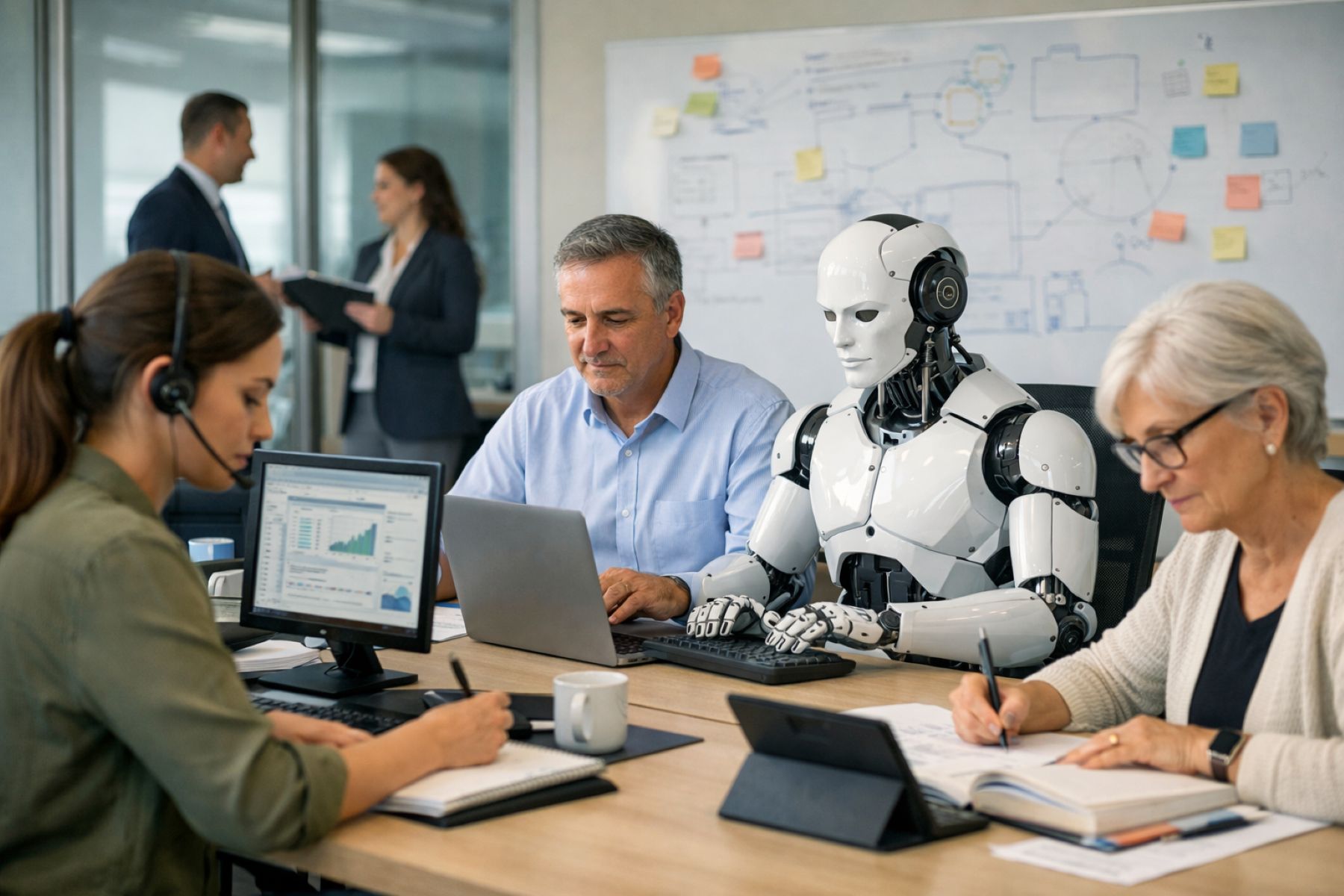
The professional world is currently navigating a quiet but profound transformation. While headlines often focus on the spectacle of what large language models can generate, a more significant shift is happening beneath the surface: the emergence of a widening AI skill gap. This gap isn’t just about knowing how to use a chatbot; it represents a fundamental divergence in how careers will be built, sustained, and accelerated through 2030.
As we look toward the next five years, the AI skill gap is becoming the primary filter through which talent is screened and promoted. It refers to the growing discrepancy between the sophisticated technical and cognitive abilities required to work alongside advanced systems and the current skill sets held by the global workforce. This divide is no longer a distant “future of work” concept—it is the defining reality for every professional today.
Redefining Entry-Level Job Requirements
The “stepping-stone” roles that once allowed graduates to learn the ropes of their industry are evaporating. Historically, entry-level positions involved high-volume, routine tasks—data entry, basic research, or drafting simple reports. Today, these are precisely the functions that AI handles with near-instant speed and high accuracy.
As a result, the barrier to entry has moved higher. Employers are no longer looking for “junior” workers to perform manual tasks; they expect new hires to arrive with “AI fluency.” This means being able to audit AI outputs, manage automated workflows, and apply critical thinking from day one. The “entry-level” role of 2026 is effectively what we used to consider a “mid-level” role in terms of responsibility and oversight.
Widening Income Inequality and the AI Skill Gap
We are entering an era of “The AI Premium.” Recent economic data from 2025 and early 2026 suggests that professionals who successfully bridge the AI skill gap are seeing wage increases of 10% to 25% compared to their peers. This isn’t limited to the tech sector; it’s happening in law, finance, and even healthcare.
Conversely, sectors with high exposure to automation but low investment in worker upskilling are seeing wage stagnation. The gap is creating a polarized labor market where the financial rewards are concentrated among those who can “augment” their productivity with technology. This shift risks deepening the divide between those in AI-integrated professional services and those in traditional manual or routine administrative sectors.
Accelerating Human-Machine Collaboration Needs
The most successful professionals of the next five years won’t be those who compete with AI, but those who master the art of “symbiosis.” We are moving away from a model of “human or machine” toward a “human + machine” partnership. In this new landscape, the machine provides the processing power and pattern recognition, while the human provides the context, empathy, and strategic judgment.
This collaboration requires a new kind of literacy. It involves knowing when to trust an algorithm and when to override it. Professionals are increasingly becoming “orchestrators” of digital agents, managing a fleet of AI tools to accomplish complex projects that would have previously required an entire team.
Increasing Demand for Ethical Oversight
As AI systems take on more decision-making power, the “human in the loop” becomes a critical safety mechanism. We are seeing a massive surge in demand for professionals who understand the ethical implications of automated systems. This includes identifying algorithmic bias, ensuring data privacy, and maintaining transparency in how AI-driven decisions are made.
This isn’t just a role for lawyers or philosophers. Every manager and executive now needs a baseline of “AI Ethics” to protect their organization from the reputational and legal risks of unmonitored automation. The ability to provide ethical oversight is quickly becoming a non-negotiable leadership trait.
Shifting Focus Toward Specialized Certification
The traditional four-year degree is no longer the sole currency of professional credibility. In a world where AI capabilities evolve every six months, a static degree can quickly become outdated. We are seeing a pivot toward “micro-credentialing” and specialized AI certifications to address the AI skill gap in real-time.
Employers are placing higher value on specific, verifiable skills—such as Prompt Engineering, AI Workflow Design, or Neural Network Fundamentals. These certifications offer a way for professionals to prove their “day-ready” status in a fast-moving market, often carrying more weight in a hiring decision than a prestige degree from a decade ago.
Automating Routine Administrative Workflows
The era of the “paper pusher” is officially ending. By 2027, it is estimated that nearly 70% of routine administrative work—scheduling, invoicing, meeting summaries, and basic project tracking—will be handled by autonomous AI agents. This shift is liberating for many, as it removes the “drudgery” of the workday.
However, it also removes the traditional “buffer” in many professional roles. With routine tasks gone, the expectation for high-value output is constant. Professionals must now focus entirely on problem-solving and relationship-building, as the “busy work” that once occupied half their day has been delegated to the cloud.
Enhancing Necessity for Lifelong Learning
The AI skill gap has turned “lifelong learning” from a buzzword into a survival strategy. The “half-life” of a technical skill is now shorter than ever. To remain relevant, professionals must adopt a mindset of continuous curiosity.
Organizations are increasingly investing in internal “Learning and Development” (L&D) platforms that use AI to personalize training for their employees. The goal is to create a workforce that can pivot as quickly as the technology does. If you aren’t learning something new about AI integration every quarter, you are likely falling behind the curve.
Reshaping Traditional Promotion Hierarchies
The “corporate ladder” is being replaced by a more fluid, skill-based web. Traditionally, promotion was based on tenure and the ability to manage people. In 2026, we are seeing “Fast-Track” promotions for individuals who can demonstrate “AI-Driven ROI”—those who have successfully implemented systems that save thousands of hours or generate new revenue streams.
Leadership is also being redefined. Managing a team now includes managing the digital tools that team uses. A “Director of Marketing” today must also be part “Marketing Technologist,” capable of auditing the AI-generated campaigns that their team oversees.
Prioritizing Critical Data Literacy Skills
In an AI-augmented world, data is the new language of business. You don’t need to be a data scientist, but you do need to be “data literate.” This means being able to interpret visualizations, understand the limitations of a dataset, and use data to tell a compelling story.
The AI skill gap often manifests as a lack of “Data Skepticism.” Professionals who blindly follow what a dashboard tells them without understanding the underlying logic are a liability. Those who can bridge the gap by combining data insights with human intuition are the ones who will lead their industries.
Transforming Remote Work Productivity Standards
AI has become the great equalizer—and the great intensifier—of remote work. With AI tools to help with communication, collaboration, and project management, a remote worker in a different time zone can be just as “present” as someone in the office.
However, the “productivity ceiling” has been raised. Because AI makes it easier to produce work, the standard for “good enough” has shifted. Remote professionals are now expected to leverage these tools to deliver higher-quality work faster, using the time saved on commuting to focus on deep, creative thinking.
Reducing Viability of Manual Tasks
For roles that rely heavily on manual precision or repetitive physical actions, the AI skill gap is a significant threat. From warehouse logistics to certain aspects of laboratory research, “Cobots” (collaborative robots) are becoming standard.
Workers in these fields must transition from “doing” to “operating.” The welder of 2026 is often a technician who programs and maintains a robotic welding arm. Those who fail to make this transition from manual execution to technical oversight will find their roles increasingly difficult to sustain.
Creating New Hybrid Professional Roles
Perhaps the most exciting outcome of the AI skill gap is the birth of entirely new career paths. We are seeing the rise of “Hybrid Roles” that blend traditional expertise with AI management. Examples include:
-
AI Bias Auditors: Professionals who ensure algorithms aren’t making discriminatory decisions.
-
Human-AI Collaboration Managers: Experts who design the workflows that allow humans and machines to work together seamlessly.
-
Prompt Architects: Individuals who specialize in communicating with complex models to produce high-level strategic outputs.
These roles didn’t exist five years ago, but they represent the “Bridge Builders” who will ultimately close the AI skill gap for the rest of the world.
A Future Built on Adaptability
The AI skill gap is not a wall; it’s a doorway. While the shift can feel daunting, it offers a unique opportunity to reclaim the “human” parts of our jobs—the creativity, the empathy, and the complex problem-solving that machines cannot replicate. The next five years will reward those who view AI as a partner in their professional journey rather than a competitor.