Why the Quantum Computer is the Next Tech Revolution
The landscape of technology is constantly shifting, but every few decades, a breakthrough emerges that promises to redefine the very fabric of how we process information. We are currently standing at the threshold of such an era with the advent of quantum computing. While the term might sound like something pulled straight from a science fiction novel, it represents a very real and tangible leap in computational science. Unlike the digital devices we use daily, these machines operate on a scale and logic that challenge our traditional understanding of physics, offering the potential to solve puzzles that would take today’s most powerful supercomputers thousands of years to crack.
Defining the Quantum Computer
At its core, a quantum computer is a specialized, high-performance machine that leverages the unique and often counterintuitive principles of quantum mechanics to perform calculations. To understand what makes it different, we first have to look at the “classical” computers we use now—from the smartphone in your pocket to the massive servers powering the internet. Classical computers process information using bits, which act like tiny light switches that are either “on” (1) or “off” (0).
Quantum computers, however, use quantum bits, or “qubits.” These bits don’t just stay in one state or the other; they exist in a realm of probability. By utilizing the laws of physics that govern subatomic particles, quantum computers can handle vast amounts of data in a way that allows for massive parallel processing. They aren’t just “faster” versions of what we have; they are an entirely different way of thinking about how information is handled.
The Fundamental Building Blocks: Qubits and Mechanics
To appreciate the sheer scale of this technology, we need to look at the specific characteristics that give quantum computers their edge. The journey begins with the qubit. Because a qubit can represent a 0, a 1, or a combination of both at the same time, the amount of information it can hold is exponentially higher than a traditional bit. This state of existing in multiple possibilities at once is known as superposition. Imagine a spinning coin; while it is spinning, it isn’t strictly heads or tails, but a blur of both. That is the essence of superposition.
Another fascinating pillar of this technology is entanglement. This is a phenomenon where two qubits become deeply linked, such that the state of one instantly influences the state of the other, regardless of the distance between them. This allows the computer to perform complex operations across a network of qubits with incredible efficiency. To guide these qubits toward the right answer, scientists use interference. Much like how noise-canceling headphones work by creating waves that cancel out background sound, quantum interference amplifies the signals leading to the correct solution while silencing the incorrect ones.
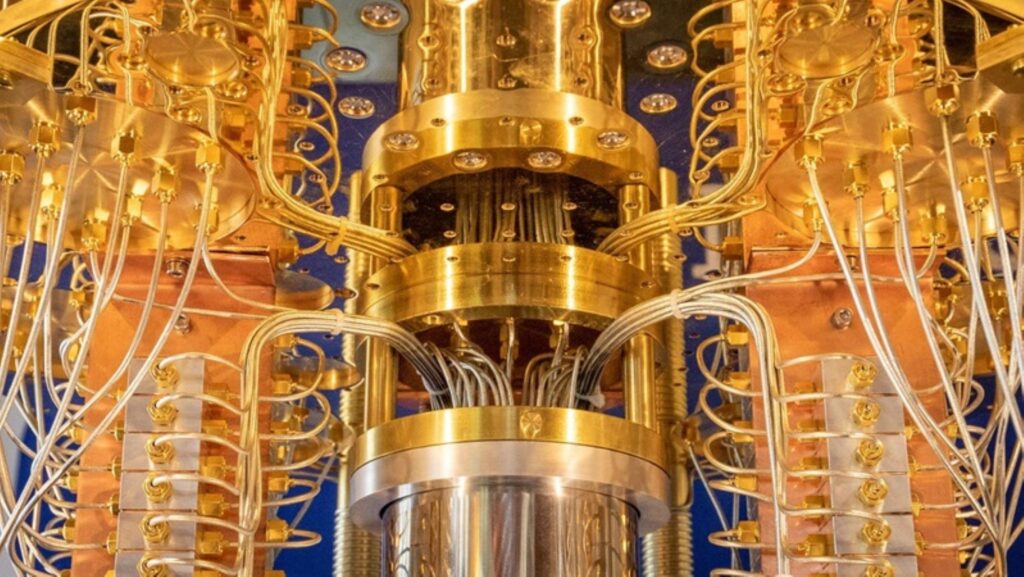
The physical hardware required to maintain these states is nothing short of an engineering marvel. Qubits are incredibly delicate and can be disrupted by even the slightest change in temperature or vibration. Because of this, most current quantum systems must be housed in specialized dilution refrigerators that keep the processor at temperatures near absolute zero—colder than the vacuum of outer space.
Real-World Applications and the Impact on Science
It is important to note that quantum computers are not intended to replace your laptop or your phone. You likely won’t be using one to check your email or browse social media. Instead, they are designed for specialized, high-complexity tasks that are currently “unsolvable” due to the sheer number of variables involved.
One of the most promising fields is Drug Discovery and Material Science. Currently, simulating how a new drug molecule interacts with the human body is an educated guessing game because molecules are quantum systems themselves. A quantum computer can simulate these molecular structures with perfect accuracy, potentially leading to cures for diseases or the discovery of revolutionary new materials for batteries and solar cells.
Furthermore, these machines excel at Optimization Problems. Whether it is a logistics company trying to find the most efficient route for thousands of delivery trucks or a financial institution trying to model the complexities of the global market, quantum computers can sift through millions of possibilities simultaneously to find the “best” path. There is also a significant focus on Cryptography. While quantum computers could theoretically break many of our current encryption methods, they are also the key to creating “quantum-secure” communication that is virtually unhackable.
The Current State: The NISQ Era and Beyond
We are currently living in what researchers call the “Noisy Intermediate-Scale Quantum” (NISQ) era. This means that while we have functional quantum computers, they are still “noisy” or prone to errors caused by their environment. We are in the experimental phase where the goal is to prove “quantum supremacy”—the point at which a quantum machine can perform a task that no classical computer can do in a reasonable timeframe.
Global tech giants like IBM, Google, Microsoft, and Amazon are in a high-stakes race to move beyond this era. They are investing billions into developing “fault-tolerant” systems that can correct their own errors. While we may still be a few years away from seeing these machines in widespread commercial use, the progress is accelerating. We are moving from the theoretical fringes of physics into a practical age of discovery that could change the world as we know it.
Understanding quantum computing requires us to embrace a bit of mystery and a lot of wonder. It reminds us that there is still so much to learn about the universe and how we can harness its fundamental laws to improve our lives. While the technology is still maturing, the potential it holds for medicine, environment, and security is truly inspiring. As we continue to refine these machines, we aren’t just building better tools; we are opening a new door to understanding the complexities of our world.