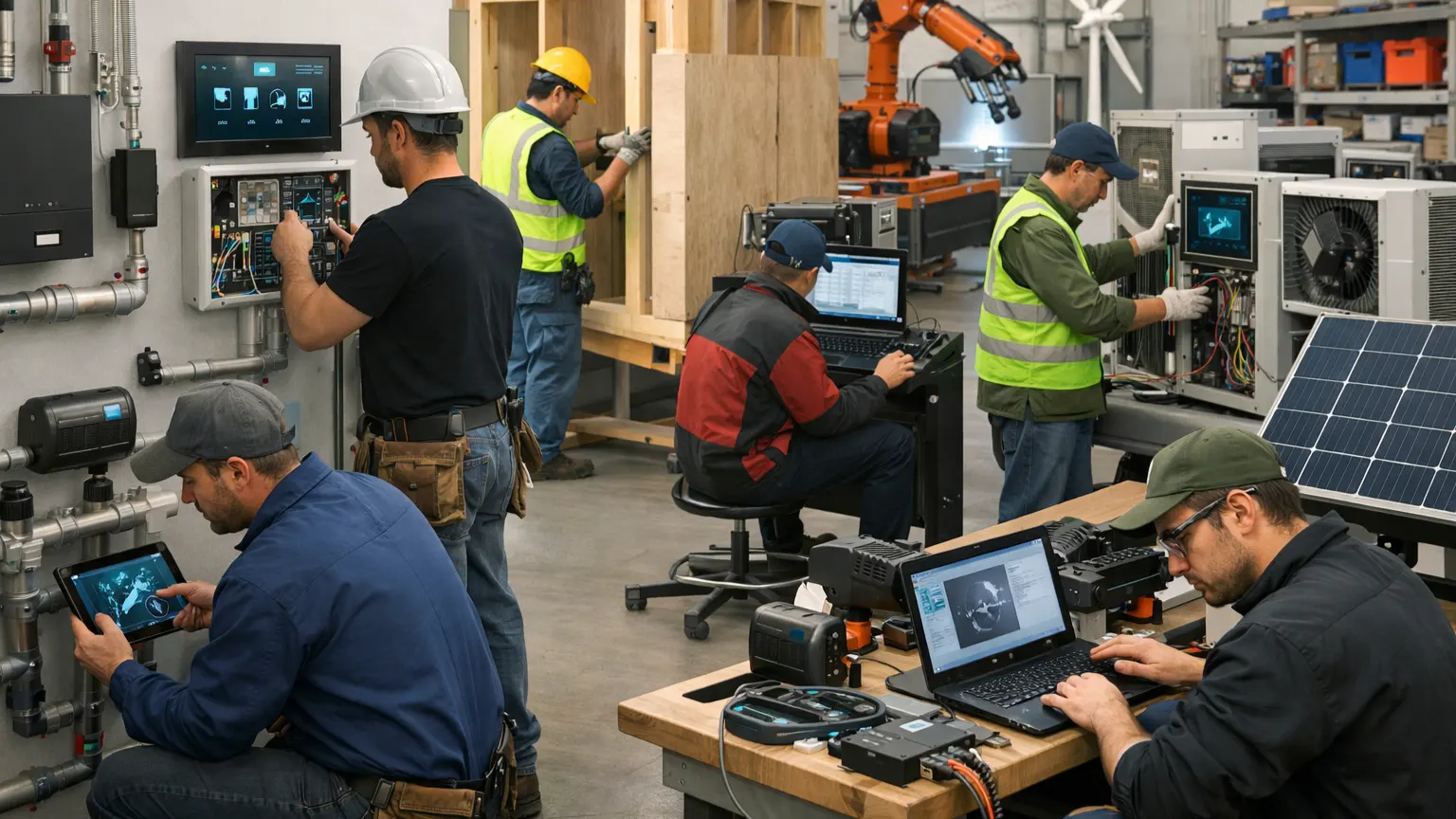
The hum of a job site is changing. Where once the sounds were dominated by the rhythmic strike of a hammer or the steady buzz of a saw, there is now a new frequency: the whir of a drone surveying a foundation, the quiet click of a tablet syncing a digital blueprint, and the soft pulse of a robotic arm executing a precision weld. For decades, the “skilled trades” were viewed as the final frontier of human-centric work—roles too gritty and physically complex for a machine to ever master. However, we are currently navigating a significant skilled trades evolution that is redefining the very nature of manual labor.
But as we move through 2026, that narrative is shifting. We are witnessing a profound transformation in how we build, fix, and maintain our world. Automation is no longer a distant threat; it is a collaborative force entering our homes and infrastructure. While the fear of technological displacement is real, the reality is far more nuanced. This isn’t just about robots replacing humans; it is the story of a “digital craftsmanship” renaissance. Those who understand this skilled trades evolution aren’t just surviving—they are becoming the most essential workers of the new economy.
Understanding the Modern Trade Vulnerability
When we talk about automation, we often focus on “replacement.” However, in the physical sectors, the vulnerability isn’t usually the job itself, but the method of execution. A robot might struggle to navigate a cluttered, 100-year-old basement to find a leaky pipe, but it can certainly automate the back-office scheduling, material ordering, and leak detection via smart sensors.
The vulnerability today lies in the “middle ground”—repetitive tasks that don’t require situational judgment. For the tradesperson, the threat of displacement isn’t a mechanical arm taking their wrench; it’s a failure to adapt to the software that dictates how that wrench is used. The “old way” of relying on paper trails is becoming obsolete, creating a gap between traditional labor and high-tech demands.
The Digital Surge in Plumbing and Electrical Work
Plumbing and electrical work are often cited as “AI-proof” because they require dexterity in unpredictable environments. Yet, even these stalwarts are seeing a massive influx of smart technology. In plumbing, we’ve moved past simple wrench-turning into the realm of fluid management and predictive maintenance.
Similarly, the electrical trade is undergoing a “smart” overhaul. As homes transition to integrated smart grids, electricians are dealing with more than just wires; they are installing smart panels and wiring complex battery storage systems. The “displacement” here is happening to those who only know how to run wire; the high-value work is shifting toward those who can program and troubleshoot the digital brains behind the power.
From Carpentry to Modular Manufacturing: A Skilled Trades Evolution
Carpentry is perhaps the trade most visibly affected by the shift toward automation. The image of a lone carpenter framing a house on-site is being challenged by the rise of modular manufacturing and 3D concrete printing. In 2026, a significant portion of residential and commercial “building” is happening in controlled factory environments.
Components are now precision-cut by CNC machines and assembled by robotic systems before being shipped to a site. This doesn’t eliminate the carpenter, but it shifts their role toward assembly oversight and specialized finishing. This skilled trades evolution means the craft is moving from the “rough cut” toward high-tech integration. The carpenters who thrive are those mastering Building Information Modeling (BIM) software, allowing them to see a digital twin of the project before a single piece of timber is touched.
The Diagnostic Evolution for Mechanics
The automotive and heavy equipment sectors have perhaps seen the most aggressive technological displacement of “old school” methods. Today’s mechanics are essentially specialized IT professionals who work with their hands.
Modern vehicles are computers on wheels, requiring sophisticated diagnostic software to identify faults. As we lean further into 2026, the transition to electric vehicles (EVs) has simplified the mechanical side while exponentially increasing software complexity. Mechanics are now “system technicians,” focusing on thermal management, high-voltage battery arrays, and autonomous sensor calibration.
Mastering Renewable Energy in HVAC
The HVAC industry is currently at the heart of the “Green Transition.” Traditional boilers are being swapped for high-efficiency heat pumps and geothermal systems. For an HVAC technician, the skilled trades evolution is about mastering the chemistry of new refrigerants and the physics of renewable energy.
Automation here takes the form of “smart climate control.” Systems now use AI to learn occupancy patterns. This means the technician’s job has shifted from simply “fixing a heater” to optimizing a complex ecosystem of energy-saving technologies. The displacement here is purely educational; if you don’t understand the software, the hardware becomes impossible to service.
Strategies for Navigating the Shift
The future of trade work isn’t about competing with machines; it’s about leading them. Here is how modern tradespeople are bridging the digital gap:
-
Become “Tech-Fluent”: Don’t fear the software. Whether it’s an ERP system for scheduling or a specialized CAD tool for design, the screen is now as important as the screwdriver.
-
Target “High-Stake” Environments: Automation thrives on repetition. It struggles with high-stakes, custom environments like hospitals and data centers. Specializing in these “unpredictable” niches provides a natural moat against displacement.
-
Focus on Hybrid Skills (Mechatronics): The most in-demand workers understand both the mechanical and the electronic. This “Mechatronics” approach allows a worker to bridge the gap between a broken motor and the faulty code driving it.
-
Invest in Continuous Certification: In 2026, a license is just the starting line. Staying relevant means picking up micro-credentials in specific technologies, such as solar installation or robotic maintenance.
Bridging the Gap in Craftsmanship
The “silver tsunami”—the wave of retirements among experienced baby boomer tradespeople—has created a critical shortage. This gap is being filled by a younger generation that is naturally tech-savvy but lacks the “gut feeling” that comes with forty years on the job. The future of the trades lies in the marriage of these two worlds: using AI to handle the heavy lifting, while using human judgment to navigate the nuances of the physical world.
We are entering an era of the “Augmented Tradesperson.” This is someone who uses an AR headset to see through a wall before they drill or a robotic assistant to lift heavy loads. Far from being displaced, the skilled worker is being upgraded through this ongoing skilled trades evolution.
The New Blue-Collar Reality
The narrative that “robots are taking our jobs” is a simplified view of a much more exciting reality. In the skilled trades, technology is acting as a force multiplier. It is making the work safer, more precise, and—ironically—more human, by stripping away the mind-numbing repetition and leaving the complex problem-solving to us.
The trades are no longer a “fallback” career; they are the premier destination for those who want to use computers to change the physical world. If you can bridge the gap between a digital blueprint and a physical structure, your place in the future economy is not just secure—it is indispensable.