






The transition from the lecture hall to the corporate world is often described as an exciting new chapter, but for many fresh graduates, it feels more like hitting a brick wall. You’ve spent years mastering theories and passing exams, yet the simple act of sending out a PDF seems to yield nothing but silence. This “black hole” of job applications usually stems from a single document: your resume. A resume isn’t just a summary of your life; it is a marketing pitch designed to win you an interview in less than six seconds—the average time a recruiter spends on their first glance.
Understanding the common resume mistakes that hold back new talent is the first step toward securing your dream role. Many graduates treat their resume as a static biography rather than a dynamic tool, failing to realize that small errors in formatting, tone, or content can lead to an immediate rejection. By identifying these pitfalls early, you can transform your application from a generic list of facts into a compelling narrative that proves your value. This guide will walk you through the fatal errors you must avoid to finally hear the phone ring.
The Standard of Professionalism
Before diving into the complex strategy of resume writing, we have to talk about the foundation. A professional resume should be as easy to read as a well-designed menu. Often, fresh graduates feel the need to stand out by using “creative” fonts or neon colors, but this usually backfires. The gold standard remains clean, legible fonts like Arial, Calibri, or Georgia. Consistency is your best friend here; if your dates are italicized in the first section, they must be italicized throughout.
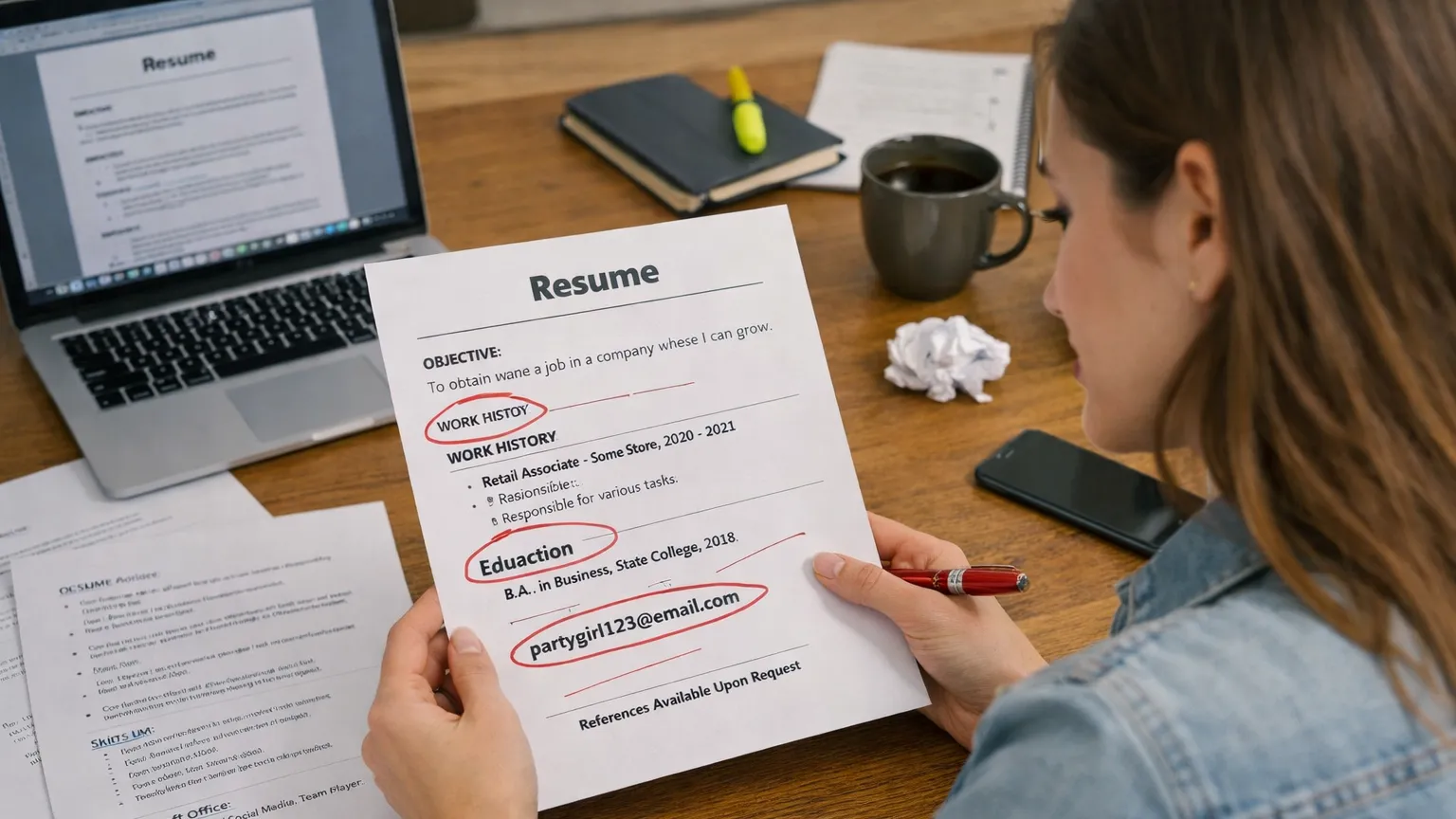
Beyond the aesthetics, your contact information is your lifeline. It sounds obvious, but you’d be surprised how many recruiters encounter “dead” phone numbers or typos in email addresses. Speaking of emails, it’s time to retire the high school handle. “SkaterBoy2022@email.com” might be nostalgic, but it doesn’t belong on a professional document. Use a simple combination of your first and last name to ensure you are taken seriously from the moment your email hits their inbox.
The Trap of the One-Size-Fits-All Resume
Perhaps the most common resume mistake is the “spray and pray” method. This is where a graduate creates one single resume and sends it to fifty different companies regardless of the job description. Recruiters can smell a generic resume from a mile away. It often features a vague “Objective Statement” like, “To obtain a challenging position where I can use my skills to grow.” This tells the employer nothing about what you can actually do for them.
Strategic tailoring is the secret sauce of successful applicants. You need to look at the job description, identify the specific keywords they are looking for, and mirror that language in your document. If a company emphasizes “Project Management” and “Data Analysis,” those terms should be prominent in your skills section. Including irrelevant experience—like that summer job as a lifeguard when you’re applying for an accounting role—only clutters the page. If it doesn’t help prove you can do the job at hand, it’s better left off.
When Structure Sabotages Success
Information hierarchy is a fancy way of saying “put the important stuff where people can see it.” For a fresh graduate, your education and relevant projects are usually your strongest assets, so they should be near the top. A frequent error in the job hunt is burying your degree under a long list of hobbies or outdated high school achievements. You want the recruiter’s eye to travel naturally from your contact info to your most impressive qualifications.
Clutter is the enemy of clarity. While it’s tempting to fill every inch of white space to look “experienced,” a wall of text is overwhelming. Use white space strategically to let the document breathe. For most graduates, a single page is the perfect length. If you’re pushing into two pages without three to five years of professional experience, you’re likely including fluff that isn’t serving you. Remember, your resume is a highlight reel, not a documentary.
Shifting from Tasks to Achievements
One of the biggest hurdles for new professionals is learning how to describe what they’ve done. Most resumes read like a grocery list of chores: “Attended meetings, wrote reports, helped customers.” This is passive and boring. To stand out and avoid common resume mistakes, you need to shift toward an achievement-based narrative. Instead of saying you “helped customers,” try: “Resolved 20+ customer inquiries daily with a 95% satisfaction rating.”
Using quantifiable data and metrics provides concrete proof of your capabilities. Even if you only have internship experience or volunteer work, you can still find numbers to share. Did you manage a budget? How many people were in your student organization? Did you improve a process by a certain percentage? Coupling these metrics with strong action verbs—like “Coordinated,” “Developed,” or “Spearheaded”—gives your resume a sense of energy and impact that a simple list of tasks never could.
The “Invisible” Errors That Kill Credibility
We live in an age of automated hiring. Most medium-to-large companies use Applicant Tracking Systems (ATS) to filter resumes before a human ever sees them. This is where formatting errors become fatal. Complex graphics, tables, and images might look pretty to you, but they often scramble the software, causing your resume to be discarded. The safest bet is to use a clean, text-based layout and always save your final version as a PDF to ensure the formatting stays locked in place.
Then there are the “human” errors: typos and grammatical slips. A misspelled word on a resume isn’t just a typo; it’s a sign that you lack attention to detail. In a competitive market, a single “there” instead of “their” can be the tie-breaker that sends your application to the “No” pile. Don’t rely solely on spellcheck; read your resume backward, or better yet, have a friend look at it. Fresh eyes will often catch the inconsistencies in bullet points or date formatting that you’ve become blind to.
Cutting the Fluff and Misconceptions
There is a lingering myth that more is always better. Fresh graduates often feel the need to include every certification they’ve ever received, even if it’s a basic “Intro to Word” certificate from six years ago. In 2026, proficiency in basic office software is usually assumed. Your space is better used for specialized skills like Python, SQL, or Advanced Financial Modeling.
Similarly, avoid the urge to include unnecessary personal details. Your marital status, religion, or a headshot (unless specifically requested in certain regions) are not relevant to your ability to do the job and can actually create unconscious bias. Keep the focus strictly on your professional persona. If you have a portfolio or a LinkedIn profile that is well-maintained and reinforces your brand, include a clickable link. This allows the recruiter to verify your skills and see your work in action without cluttering the physical page.
Practical Tips for Avoiding Common Resume Mistakes
So, how do you put this all together? Start by building a “Master Resume” that contains every single thing you’ve ever done. Then, for every job application, create a “Targeted Resume” by pulling only the most relevant pieces from your master file. This saves you time while ensuring your application is always personalized.
-
Use the STAR Method: For your bullet points, think in terms of Situation, Task, Action, and Result.
-
Check Your Links: Ensure your LinkedIn and portfolio links actually work.
-
The “Jargon” Balance: Use industry terms to show you’re an insider, but don’t overdo it to the point where it’s unreadable.
-
Proofreading Hack: Read your resume out loud. If you stumble over a sentence, it’s too long or too complex.
Closing the Gap to Your First Job
Your resume is the bridge between your education and your career. While the list of “don’ts” can seem daunting, avoiding these common resume mistakes is actually an empowering process. It forces you to look at your achievements critically and present yourself as the professional you are becoming, rather than the student you were. A clean, targeted, and achievement-oriented resume doesn’t just get you past the ATS; it gives you the confidence to walk into an interview knowing you belong there.
Take a moment today to open your current resume file. Look at it through the eyes of a busy recruiter who has 300 other applications to read. Does your value jump off the page, or is it hidden behind a wall of generic text and formatting errors? Fixing these mistakes is a small investment of time that can pay dividends for the rest of your career.






No Response