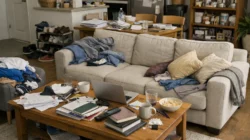

We have all walked into that one friend’s house that feels effortlessly serene. The pillows are plumped, the surfaces are gleaming, and there isn’t a stray shoe in sight. It is easy to look at a tidy living room and assume the home is organized, but true order is rarely about what is visible on the surface. In fact, surface-level tidiness is often just a clever mask for “doom piles” hidden in closets. To achieve a functional space, one must develop home organization habits that go deeper than a quick dusting before company arrives.
The real magic of a functional home lies in the systems that hum quietly in the background. A truly organized household isn’t designed for the eyes of a guest; it is designed for the peace of mind of the people who live there. It’s about reducing the “mental load”—the invisible weight of remembering where the batteries are or knowing exactly when the winter coats need to come out of storage.
When your home is organized beneath the surface, your daily routines move from a state of friction to a state of flow. You stop searching for keys, you stop rebuying spices you already own, and you start reclaiming the time lost to domestic chaos. If you’ve ever wondered if your home is truly organized or just “clean,” there are a few hidden hallmarks that tell the real story.
The Anatomy of Internal Order
The transition from a cluttered life to an organized one usually starts with a shift in perspective. Most people approach organization as a weekend project—a frantic burst of energy to clean the garage. However, sustainable home organization habits are built on the logic of accessibility. It’s the difference between “putting things away” and “putting things where they belong.”
When we look deeper than the freshly vacuumed rugs, we find the skeletal structure of a home. These are the zones that guests never see, but they are the very things that keep a household from collapsing into a state of “where is my…?” frustration.
Optimized Kitchen Cabinet Interior Systems
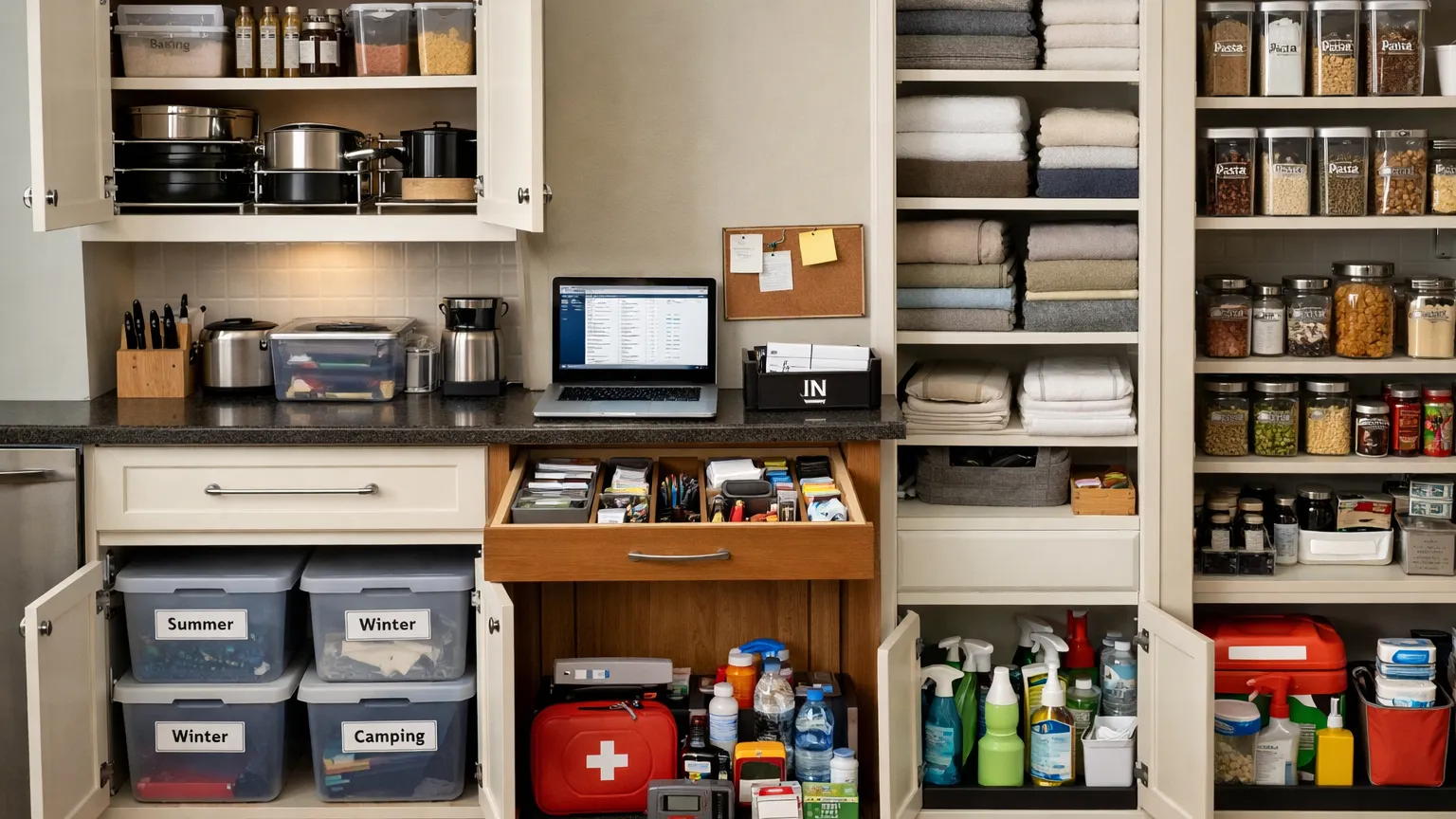
The kitchen is the heart of the home, but the cabinets are often the junk drawers of the culinary world. A truly organized kitchen isn’t just about clear countertops; it’s about what happens when you reach for a pot lid. In a high-functioning home, cabinets are optimized with tiered shelving, pull-out organizers, and tension rods that prevent the “avalanche effect.”
When you open a cabinet and see that the heavy Dutch oven is at waist height while the rarely-used turkey roaster is tucked up high, you’re looking at intentionality. It’s about the “zone” method—keeping the coffee pods near the machine and the baking sheets near the oven. This subtle logic saves seconds every day, which compounds into hours of saved frustration every year.
Systematic Seasonal Clothing Storage Labels
We often treat our closets like a game of Tetris, stuffing summer dresses behind winter parkas until the rod begins to groan. An organized household, however, treats clothing storage as a rotating gallery. The hidden indicator here isn’t just that the clothes are off the floor; it’s the presence of a seasonal rotation system.
When the off-season wardrobe is tucked away in uniform, labeled bins—perhaps sorted by family member or garment type—the morning routine becomes infinitely smoother. This reflects disciplined home organization habits that prevent “closet fatigue” from digging through wool sweaters in mid-July. This system shows a respect for one’s belongings and a clear understanding that space is a finite resource.
Functional Junk Drawer Categorization Methods
Every home has one. The “junk drawer” is a universal human constant, but in a truly organized home, it’s a misnomer. Instead of a graveyard for dead batteries and mystery keys, an organized junk drawer is actually a “utility hub.”
The indicator of a pro-level organizer is the use of small dividers or acrylic trays within that drawer. It sounds obsessive, but when paperclips, stamps, and screwdrivers each have a dedicated square inch, the drawer ceases to be a source of stress. It becomes a reliable resource. It’s the ultimate sign that the homeowner has mastered the “small stuff” that usually creates the most mental friction.
Consistent Digital File Filing Structures
In the modern age, a home’s organization extends beyond the physical walls and into the digital ether. You can have a pristine minimalist living room, but if your computer desktop is a sea of 400 unnamed PDFs, your life isn’t truly organized.
The hidden hallmark of a streamlined life is a consistent digital filing system. This means tax documents, medical records, and digital photos are stored in folders with a logical naming convention (e.g., YYYY-MM-Description). When you can find a receipt from three years ago in under thirty seconds, you’ve reached a level of domestic efficiency that most only dream of.
Logical Linen Closet Stacking Protocols
The linen closet is frequently the first place to descend into chaos. We’ve all been there: pulling out one towel only to have three pillowcases and a fitted sheet tumble onto our heads. A truly organized household employs “stacking protocols.”
This often involves the “burrito fold” for sheet sets (tucking the entire set inside one pillowcase) or vertical folding for towels. When you see a linen closet where the edges are uniform and the oldest linens are at the bottom of the stack to ensure even wear, you are looking at a system built for longevity. It’s a quiet, tucked-away victory over the entropy of daily life.
Dedicated Incoming Mail Processing Zones
Mail is the primary source of “paper creep” in the home. It starts on the entryway table, migrates to the kitchen island, and eventually forms a mountain on the dining room chair. An organized home stops this cycle at the front door with a dedicated processing zone.
This isn’t just a basket; it’s a system. There is a place for “To File,” “To Action,” and a recycling bin within arm’s reach for the junk mail. By deciding the fate of a piece of paper the moment it enters the house, the organized homeowner prevents the clutter from ever actually “landing.”
Uniform Pantry Container Labeling Standards
While social media has made “pantry aesthetics” a trend, the real value of uniform containers isn’t the look—it’s the visibility. Decanting flour, sugar, and pasta into clear, labeled containers allows you to see exactly what you have at a glance.
This is a hidden indicator because it affects how a household shops and eats. It prevents “duplicate buying” (the phenomenon of buying more salt because you couldn’t find the three boxes hidden in the back). When a pantry is labeled, anyone in the house can find what they need without shouting for help.
Streamlined Cleaning Supply Accessibility Points
Most people keep all their cleaning supplies under the kitchen sink. An organized person, however, realizes that if the glass cleaner is on the first floor and the smudge is on the second floor, the smudge stays there for a week.
A hidden sign of a functional home is “point-of-use” storage. This means having a small caddy of supplies in every bathroom and the laundry room. By making the tools of maintenance immediately accessible, the act of cleaning becomes a series of quick “micro-tasks” rather than a grueling Saturday marathon.
Preplanned Emergency Resource Storage Kits
Finally, the most “hidden” indicator of all is the one you hope you never have to see: the emergency kit. Whether it’s a power outage or a minor injury, a truly organized household is prepared for the unexpected.
This goes beyond a dusty first-aid kit. It’s a dedicated, easily accessible zone containing fresh water, flashlights with working batteries, and a “go-bag” of essential documents. It shows a level of foresight that moves past daily aesthetics and into the realm of family security.
Cultivating the Organized Mindset
If looking at this list feels overwhelming, remember that effective home organization habits aren’t formed in a day. You don’t need to go out and buy a label maker and fifty acrylic bins this afternoon. True organization is a gradual process of identifying where your daily life feels “sticky”—where you lose time, where you get frustrated, or where you feel embarrassed to open a door.
Practical Steps to Get Started:
-
Audit Your Hotspots: Identify the one drawer or shelf that irritates you the most. Don’t do the whole room; just do that one square foot.
-
The “One-Touch” Rule: Try to process items (like mail or laundry) only once. Instead of putting it down, put it away.
-
Uniformity Over Complexity: When buying storage, stick to one style of bin. It makes things stackable and visually cohesive without extra effort.
-
Label the Invisible: Even if you think you’ll remember what’s in the box, you won’t. Labeling is a gift to your future self.
Living in a truly organized home is less about the “look” and more about the “feel.” It’s the quiet confidence of being the master of your domain.