






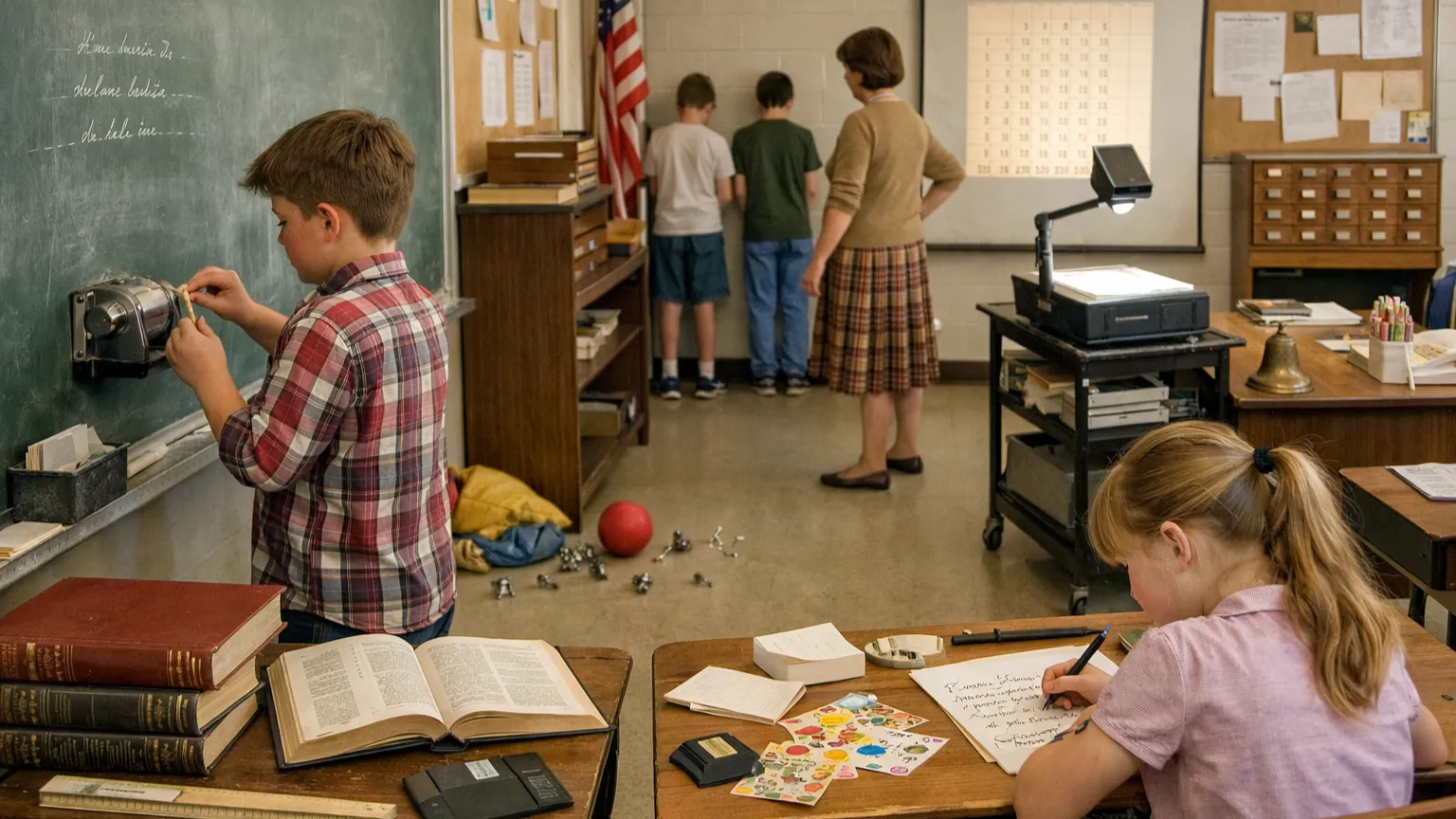
Walking past a schoolyard today feels remarkably different than it did thirty years ago. The air used to smell of chalk dust and floor wax, punctuated by the mechanical grind of a pencil sharpener or the rhythmic “thwack” of a heavy textbook hitting a wooden desk. While modern classrooms are marvels of efficiency—clutter-free, digital, and sleek—there is a certain tactile soul and a wealth of nostalgic school memories that have vanished along with the analog tools of the past. If you grew up before the era of tablets and smartboards, you likely remember a version of education that was grittier, louder, and arguably more communal. Exploring these lost fragments of school life isn’t just a trip down memory lane; it’s a way to understand how much our daily interactions and learning habits have shifted in just a single generation.
The Tactile Reality of the Analog Classroom
The centerpiece of the old-school classroom was, undoubtedly, the chalkboard. It wasn’t just a tool for instruction; it was a sensory experience. There was a specific skill to writing with a fresh piece of chalk without making that bone-chilling screech, and being asked to “clap the erasers” at the end of the day was both a chore and a bizarrely satisfying ritual. You’d stand outside, hitting two felt blocks together until a cloud of white dust coated your clothes and hair—a badge of honor that signaled you were the teacher’s helper for the day.
Then there were the overhead projectors. Long before PowerPoint, teachers would carefully lay down clear plastic transparencies. We watched as they wrote in colorful wet-erase markers, their oversized hands projected onto the screen. If the fan on the projector was too loud, or if the bulb blew out mid-lesson, the entire class came to a standstill. It was a slow, deliberate way of learning that required patience.
Physical Knowledge and Nostalgic School Memories
Everything felt heavier then. Instead of a slim laptop, we lugged around printed encyclopedias that smelled of old paper and glue. If you wanted to know about the solar system or the Ming Dynasty, you didn’t “Google” it; you hauled Volume ‘S’ or ‘M’ off the shelf and flipped through thousands of thin, rustling pages. There was a weight to knowledge—literally. Even sharpening a pencil was a mechanical feat. You’d stick your Ticonderoga into the wall-mounted sharpener and crank the handle until your arm ached, listening for that specific change in pitch that meant the point was finally sharp enough to break.
A Different Standard of Discipline and Duty
The social contract between student and teacher has undergone a massive transformation. In the traditional era, authority was absolute and rarely questioned. Discipline wasn’t just about detention slips; it was often visible and physical. It wasn’t uncommon to see a student standing in the hallway, nose to the wall, or tucked into a corner as a silent lesson in humility.
Detention itself often involved “sweat equity.” Instead of sitting silently in a room, you might be handed a broom or a rag. Cleaning the classroom, scrubbing graffiti off desks, or weeding the school garden weren’t seen as “labor violations” but as ways to restore the community you had disrupted. We took a strange pride in the school grounds because we were the ones who maintained them.
This extended to our personal appearance. Morning inspections were a standard hurdle. Teachers would walk down the rows, checking for tucked-in shirts, polished shoes, and hair that didn’t touch the collar. It felt strict, perhaps even stifling at the time, but it instilled a sense of “uniformity” that made the school feel like a distinct world apart from our lives at home.
The Secret Language of Recess and Hallways
Socializing in the pre-digital era was an analog art form. Without text messages or DMs, the “folded paper note” became the primary currency of the classroom. These weren’t just scraps of paper; they were masterpieces of origami, tucked into intricate squares or “pull-tab” shapes to ensure privacy. Passing one was a high-stakes mission that required timing, stealth, and a trusted network of intermediaries. If a teacher intercepted a note, your deepest secrets were suddenly public property.
Recess was a far more unscripted affair. We played in dirt, scraped our knees on asphalt, and engaged in games like marbles, jacks, or hopscotch—activities that required physical pieces you carried in your pockets. Trading stickers or “slap bracelets” was the closest we had to a social media feed. Your collection defined your status.
One of the most cherished traditions and sources of nostalgic school memories was the autograph book or the “slams” book. Near the end of the year, we would pass around colorful journals where friends would draw elaborate doodles, write poems, or leave “H.A.G.S” (Have A Great Summer) messages. These weren’t just comments on a wall; they were physical keepsakes that caught the ink of your friends’ handwriting, serving as a permanent record of a specific moment in time.
The Methodology of Rote and Rigor
The way we processed information was fundamentally different. We spent hours on cursive handwriting, looping ‘G’s and ‘S’s until the motion became muscle memory. We didn’t have spellcheck, so we learned the rhythm of words. In math, we didn’t just use calculators; we used slide rules or, more commonly, we stood in rows and chanted multiplication tables in unison. The “times tables” were a rhythmic song that stayed in your head for decades.
Researching a paper was an expedition. You’d head to the library and face the towering oak drawers of the card catalog. You’d flip through thousands of index cards, hunting for a Dewey Decimal number, then wander through the stacks hoping the book hadn’t been checked out. It was a hunt that taught us the value of the information we eventually found.
Even the way we saved our work felt precarious. We lived in the era of the floppy disk. Those 3.5-inch squares were fragile; a stray magnet or a bit of dust could erase your entire term paper. There was no “cloud” to save you. You learned to be meticulous, to make backups, and to handle your tools with a level of care that digital files simply don’t demand today.
Vanishing Customs and Nostalgic School Memories
Finally, there were the administrative rhythms that dictated the pulse of the day. The school bell wasn’t an electronic chime or a soft buzz; it was often a literal metal bell rung by a student or a loud, vibrating clanger that could be heard three blocks away. Every morning started with a standardized routine—often involving calisthenics or a formal assembly—that signaled the transition from “child” to “student.”
Teachers didn’t use digital portals to track progress. They carried heavy, leather-bound grade books. Seeing a teacher open that book and pick up a red pen was enough to send a shiver down any student’s spine. Communication with parents happened via typed newsletters that arrived in the physical mail once a month, or a handwritten note “pinned” to a younger student’s sweater. There was a delay in communication that allowed for a certain level of independence (and occasionally, the ability to “lose” a bad report card for a few days).
Preserving the Spirit of the Past
While it’s easy to look back with rose-colored glasses, we shouldn’t forget that the modern era has brought incredible accessibility, safety, and efficiency to education. We no longer have to worry about the “dust lung” from chalk or the frustration of a lost library book. However, the loss of these iconic elements does mean the loss of a certain type of resilience and tactile connection to our environment.
These nostalgic school memories remind us that the traditional school era taught us how to wait, how to fix things that were broken, and how to communicate without the shield of a screen. Whether you’re a parent, a teacher, or someone who simply remembers the smell of a fresh mimeograph sheet, there is value in keeping these memories alive. They remind us that learning is as much about the “how” as it is about the “what.”






No Response