







In a world that seems to reinvent itself every six months, the gap between generations often feels less like a crack and more like a canyon. We live in an era of rapid societal evolution, where digital transformation has rewritten the rules of how we work, shop, and even love. Yet, amidst the whirlwind of high-speed internet and AI-driven convenience, a specific set of Baby Boomer habits remains remarkably resilient. These are the hallmarks of a generation—those born between 1946 and 1964—who grew up in a world defined by physical presence, manual processes, and tangible results.
While younger generations might view some of these tendencies as outdated relics, there is a profound cultural value persistence behind them. These behaviors aren’t just about “doing things the old way”; they are reflections of a worldview that prioritizes stability, direct connection, and sensory experience. Understanding these traditional behaviors isn’t just a lesson in history; it’s an opportunity to see what we might be losing in our rush toward a fully virtual existence. By exploring these nine enduring habits, we can gain insight into the generation that built the modern world and discover why their “old-fashioned” ways might still hold the keys to a more grounded life.
1. Why do Baby Boomers still prefer physical newspapers?
For many Boomers, the day doesn’t truly begin until the rustle of newsprint fills the kitchen. While Millennials and Gen Z are accustomed to a never-ending scroll of algorithmic news feeds, this demographic often clings to the tactile reading experience of a physical newspaper. There is a specific sensory satisfaction in the smell of the ink and the weight of the broadsheet that a cold glass screen simply cannot replicate.
Beyond the sensory, the newspaper represents a curated daily information flow. In an age of information overload, the paper provides a finite beginning and end to the news cycle, offering a sense of completion that “refreshing for updates” never allows. This Baby Boomer habit is deeply tied to established morning routines—a moment of quiet reflection before the chaos of the day. Furthermore, there remains a deep-seated trust in traditional media; a printed word carries more weight and accountability than a fleeting post, representing a commitment to editorial standards.
2. The persistence of voice calls over texting
If you want to reach a Baby Boomer, you don’t send a “quick check-in” text; you pick up the phone. To this generation, the persistence of voice calls is about honoring a direct personal connection. They grew up in an era where the telephone was a lifeline, and a person’s voice carried the nuances of emotion, hesitation, and warmth that an emoji often fails to capture.
There is a practical side to this as well: faster message clarity. Why spend five minutes back-and-forth on a messaging app when a thirty-second conversation can resolve the issue? For many, auditory social interaction reduces the risk of digital misinterpretation. They value real-time feedback, believing that if something is worth saying, it’s worth saying with your own voice.
3. Reliance on physical bank branches and cash
In the eyes of many Boomers, money isn’t just a number on a screen; it’s something you should be able to hold and see. This reliance on physical bank branches and cash stems from a desire for tangible financial security. While mobile banking offers convenience, it lacks the personalized customer service that comes from walking into a building and speaking to a teller who knows your name.
This behavior is often fueled by a healthy distrust in digital-only banking. Having lived through various economic shifts, Boomers find comfort in physical record-keeping—printed receipts, passbooks, and monthly statements arriving by mail. There is a psychological safety in knowing exactly where your assets are, making the “brick and mortar” bank a symbol of stability in a volatile digital economy.
4. High-value Baby Boomer habits: Printing digital documents
“I’ll print a copy so I can really look at it.” This phrase is a staple of Boomer professional life. Despite the push for “paperless” offices, the habit of printing digital documents remains strong. For many, it allows for easier physical annotation; scribbling notes in the margins or highlighting text with a physical pen helps with information retention and cognitive processing.
Additionally, a physical piece of paper serves as a reliable backup format. This practice also addresses a modern health concern: reduced digital eye strain. Reading a long report on paper is simply easier on the eyes than staring at a backlit monitor for hours. It’s a professional tradition that values the permanence of the physical record over the ethereal nature of a digital file.
5. Strict adherence to formal workplace dress codes
The shift toward “Silicon Valley casual” hasn’t entirely erased the belief in the power of a suit or a well-pressed blouse. For this generation, strict adherence to workplace dress codes is about professional authority signaling. They were raised with the philosophy that you “dress for the job you want,” and that appearance is an outward sign of discipline and respect.
This Baby Boomer habit helps maintain clear career boundaries. Putting on professional attire is a mental ritual that signals the start of the workday, while taking it off marks the return to private life. In an era where home and office lines have blurred, insistence on established corporate standards offers a structured approach to professional identity.
6. Preference for brand loyalty and local shopping
While younger consumers might chase the lowest price or the trendiest new startup, Boomers often exhibit deep-seated brand loyalty. This isn’t just about repetition; it’s about long-term trust building. If a brand has treated them well for thirty years, they see no reason to switch. This loyalty extends to their local communities, where they prioritize in-person product inspection.
There is a communal aspect to this: community economic support. Boomers understand that shopping locally keeps their neighborhoods vibrant. They value the predictable quality assurance that comes from seeing and touching a product before buying it, rather than gambling on a grainy photo from an overseas marketplace.
7. Maintaining a fixed home landline
In an age of ubiquitous smartphones, the presence of a landline in a Boomer household can seem like an anomaly. However, it remains a matter of emergency reliability. Landlines often work when cell towers are down or during power outages, providing a sense of safety that a battery-dependent device cannot.
Beyond safety, there is the factor of superior audio quality. It is also a generational communication habit—the “home phone” represents a consistent contact location. It’s the number associated with the family unit, acting as a fixed point in a world where everyone is constantly on the move.
8. Traditional television and scheduled viewing
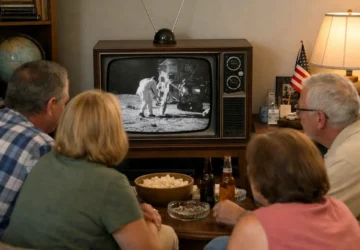
While streaming services have revolutionized media, many Boomers still find comfort in traditional television and scheduled viewing. There is a specific passive entertainment comfort in “flipping through the channels” and stumbling upon a movie or news program. It removes the “paradox of choice” that often comes with on-demand platforms.
Moreover, scheduled TV creates shared national experiences. Whether it’s the evening news or a major sporting event, there is a sense of connection in knowing that others are watching the exact same thing simultaneously. Familiar channel navigation provides a structured rhythm to the evening that many still prefer.
9. High value on home ownership and physical assets
Perhaps the most significant of all Baby Boomer habits is the high value placed on home ownership and physical assets. For this generation, a home isn’t just a place to live; it’s the cornerstone of long-term financial stability. Having come of age during periods of significant growth, they view property as the ultimate tangible legacy-building tool.
This focus on physical assets—whether real estate, gold, or collectibles—stems from a desire for personal independence goals. They want to own the roof over their heads and have an inflation-resistant investment they can control. In a world of digital stocks and crypto-currencies, this preference for “real” assets remains a testament to their belief in the power of the physical world.
Navigating the Generational Bridge
Understanding these Baby Boomer habits isn’t about deciding which generation is “right.” Instead, it’s about recognizing that these traditional behaviors offer unique benefits—focus, stability, and human connection—that are sometimes lost in our digital frenzy. Whether it’s the reliability of a printed document or the warmth of a voice call, there is much to be learned from the Boomer approach to life.
If we look closely, we might find that a “hybrid” lifestyle—one that embraces modern tech while holding onto the best of these traditional habits—is the most fulfilling path forward.





No Response