

In an era defined by lightning-fast deliveries and the constant hum of digital consumerism, it is easy to look back at the 1960s as a time of simple scarcity. However, looking through the lens of frugal parenting psychology, we see that what many now consider “doing without” was actually a profound exercise in building character. The mid-century household wasn’t just saving pennies; it was inadvertently creating a psychological framework that allowed children to thrive under pressure. By modern standards, the lifestyle was modest, but the emotional dividends it paid in the form of resilience and grit were remarkably high.
Understanding Frugal Parenting Psychology
At its core, frugal parenting psychology refers to a child-rearing approach that prioritizes resourcefulness, intentionality, and the distinction between needs and wants. Unlike forced poverty, which is characterized by chronic stress, intentional frugality focuses on the stewardship of resources. In the 1960s, this wasn’t necessarily a “parenting trend” found in books; it was a cultural baseline. This mindset teaches children that their value is not tied to the novelty of their possessions, but rather to their ability to adapt, wait, and create within their means. This foundation is essential for developing a sense of agency and emotional stability.
Prioritizing Essential Needs Over Wants
One of the most striking differences between the 1960s and today is the clear boundary that existed between a “need” and a “want.” Most children of that era understood that a new pair of shoes was a necessity for the school year, while a trendy toy was a rare luxury. By consistently prioritizing essentials, parents taught their children how to categorize their desires. This clarity helped children develop a grounded perspective on reality, preventing the “instant gratification” loop that often leads to frustration in adulthood when life doesn’t deliver immediate rewards.
Mastering the Art of Delayed Gratification
The concept of waiting for something special—whether it was a birthday gift or a seasonal treat—was a cornerstone of 1960s childhood. Psychology tells us that the ability to delay gratification is one of the strongest predictors of long-term success. Because 1960s households often operated on strict budgets, children learned that good things come to those who wait and work. This patience became a mental muscle, allowing them to handle the inevitable delays and setbacks of adult life with far less anxiety than those accustomed to “on-demand” satisfaction.
Developing Resourceful Problem-Solving Skills
When something broke in a frugal 1960s household, the first instinct wasn’t to browse an online catalog for a replacement. Instead, the toolbox came out. Children watched their parents mend clothes, fix appliances, and repurpose old materials. This environment turned every broken item into a lesson in engineering and creativity. By learning to “make do or mend,” children developed a “can-do” attitude, viewing challenges as puzzles to be solved rather than insurmountable obstacles that required a credit card to fix.
Normalizing Hand-Me-Down Clothing Items
In many modern circles, there is a social stigma attached to second-hand goods, but in the 1960s, the “hand-me-down” was a rite of passage. Passing clothes from an older sibling to a younger one normalized the idea that an object’s value lies in its utility, not its brand-new shine. This practice subtly deconstructed the ego, teaching children that they didn’t need a pristine, unique wardrobe to fit in or feel confident. It fostered a sense of community and shared family history through the very fabric they wore.
Reducing Dependence on Material Validation
Because 1960s families generally had fewer possessions, children were forced to find identity in their actions, hobbies, and character rather than their “stuff.” There was less pressure to keep up with an ever-changing cycle of trends because the cycle moved much slower. This reduction in material competition allowed for a more stable self-image. When a child’s self-worth isn’t anchored to the latest gadget, they become much more resilient to the social fluctuations and status games that often cause mental health strain in highly consumerist societies.
Fostering Deep Appreciation for Small Joys
Frugality has a way of sharpening the senses. In a world where every whim isn’t catered to, the “small” things become monumental. A trip to the local park, a home-cooked Sunday roast, or a shared comic book felt like a grand event. This high “joy-sensitivity” is a key component of frugal parenting psychology. It trains the brain to find dopamine in simple, sustainable activities. Adults who grew up this way often find it easier to maintain a positive outlook because they don’t require expensive external stimuli to feel content.
Encouraging Manual Labor and Household Chores
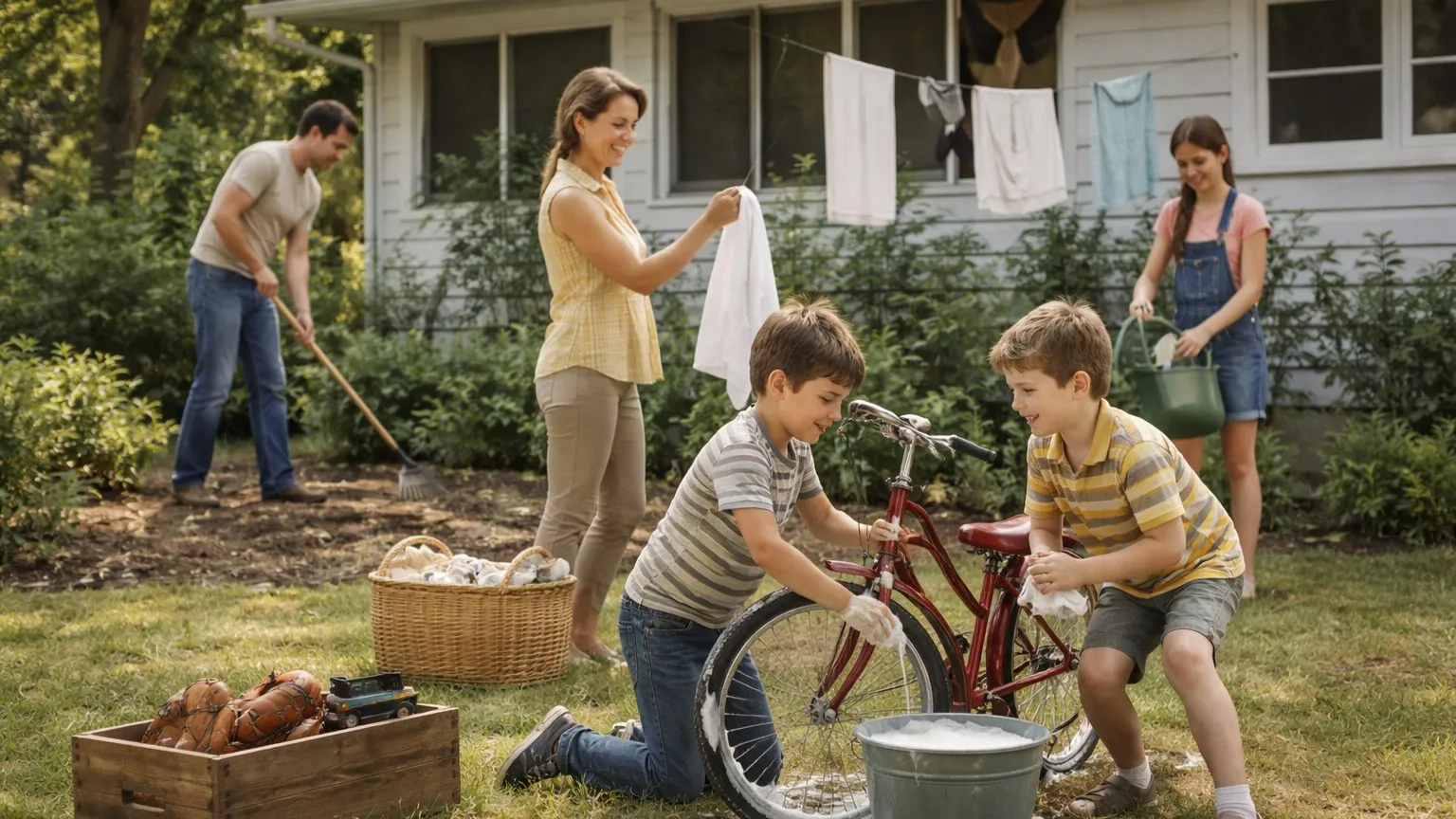
Frugal living in the mid-20th century was often labor-intensive. Children were expected to contribute to the household, whether it was helping with the garden, hanging laundry on the line, or washing the car by hand. These chores weren’t just about getting work done; they were about teaching the value of effort. By engaging in manual labor, children learned that their environment was something they could influence and maintain. This fostered a sense of responsibility and a deep-seated understanding that rewards are earned through consistent action.
Building Patience Through Slow-Paced Living
Life in the 1960s was inherently slower. Information moved by mail, entertainment was scheduled by broadcasters, and travel took time. Frugal families leaned into this pace by necessity. This “slow living” environment allowed children’s nervous systems to develop without the constant “ping” of digital interruptions. It built a specific type of mental endurance—the ability to sit with one’s thoughts, to endure boredom, and to focus on a single task for a long duration. These are the very skills that comprise modern mindfulness.
Strengthening Family Bonds Through Shared Frugality
Frugality is often a team sport. When a family works together to save for a specific goal or manages a tight budget, it creates a “we’re in this together” mentality. In the 1960s, children were often aware of the family’s financial boundaries, which fostered a sense of empathy toward their parents’ hard work. Instead of feeling deprived, children felt like valued members of a functional unit. These shared experiences of modest living created deep emotional bonds and a sense of security that no amount of expensive toys could replicate.
Learning Value from Maintaining Existing Possessions
There is a profound psychological shift that occurs when you are taught to oil a bicycle chain or polish your own shoes. In the 1960s, maintaining what you owned was a sign of respect and discipline. Children learned that if they took care of their things, their things would take care of them. This lesson in stewardship extends to all areas of life, including relationships and physical health. It teaches that longevity and quality are the results of ongoing care and attention, rather than disposable convenience.
Developing Early Financial Literacy and Awareness
While they might not have been checking stock tickers, children in frugal 1960s homes had a front-row seat to real-world economics. They saw cash being counted into envelopes for different expenses and understood that once the money was gone, it was gone. This transparent relationship with money provided an early, practical education in financial literacy. Understanding the finite nature of resources at a young age prevents the “magic money” fallacy and helps develop the analytical skills necessary to manage a household in adulthood.
Cultivating Grit Through Consistent Modest Living
Grit—the passion and perseverance for long-term goals—is often forged in the fires of moderate challenge. The “inconveniences” of a frugal 1960s lifestyle, such as walking to school or living without air conditioning, were actually low-stakes training for the hardships of life. By navigating a world that wasn’t perfectly curated for their comfort, children developed a “thick skin.” They learned that they could be uncomfortable and still be okay, which is the very definition of psychological resilience.
Reducing Anxiety from Social Status Competition
In a community where most families are living similarly modest lives, the “comparison trap” is significantly weakened. The 1960s lacked the digital window into the curated, wealthy lives of others that we have today. By applying the principles of frugal parenting psychology, parents protected children from the constant feeling of “not having enough.” Without the relentless pressure to display status through consumption, children could focus on their personal development and social connections, leading to lower levels of social anxiety and a more authentic sense of self.
Enhancing Creativity Through Limited Toy Selections
The phrase “boredom is the mother of invention” was never truer than in a frugal 1960s backyard. With fewer specialized toys, children had to use their imaginations to turn a cardboard box into a spaceship or a stick into a sword. This type of “open-ended play” is essential for cognitive development. When toys do less, the child’s mind must do more. This early exercise in divergent thinking—the ability to see multiple uses for a single object—is a foundational skill for creative problem-solving in any professional field.
Valuing Experiences Over Expensive Consumer Goods
Ultimately, the 1960s lifestyle emphasized that the best things in life aren’t things. Family picnics, neighborhood ball games, and evening stories were the highlights of the week. By de-emphasizing consumer goods, parents taught their children to invest their emotions in experiences and relationships. This shift in values created adults who are often more satisfied with life, as they understand that lasting happiness comes from the quality of their interactions and the depth of their memories, rather than the contents of their closets.
A Legacy of Resilience
Looking back, the frugal parenting psychology of the 1960s offers a powerful blueprint for modern living. While we certainly wouldn’t want to trade away the medical and technological advancements of today, we can still adopt the core values of that era. By teaching our children the value of a dollar, the beauty of a repaired item, and the strength found in patience, we give them a gift far more valuable than any gadget: the mental resilience to face an unpredictable world with confidence and grace.