

In the grand tapestry of history, few cohorts have sparked as much cultural debate and occasional friction as the Baby Boomers. Born between 1946 and 1964, this generation didn’t just witness change; they were the architects of a massive global shift. When we analyze the Baby Boomer upbringing, we aren’t just discussing a trip down memory lane filled with record players and milk bottles. Instead, we are exploring a unique socio-economic petri dish that cultivated specific values—resilience, institutional respect, and a distinct “pull yourself up by your bootstraps” grit—that continue to influence how they view work, family, and politics today.
Understanding the Boomer perspective requires us to look past the memes and the “OK Boomer” retorts. It demands a look at the specific environment that shaped their formative years. For younger generations, the Boomer childhood can seem like a foreign world—one defined by a strange paradox of immense economic optimism and the looming shadow of the Cold War. By dissecting these roots, we gain more than just historical context; we gain a bridge for better communication and a deeper appreciation for how our environments dictate our adult identities.
The Foundation of Stability and the Nuclear Ideal
The early years of the Baby Boomer upbringing were cradled by an era of unprecedented economic expansion. Emerging from the shadows of World War II, the global economy entered a “Golden Age.” For many children of this era, this translated into a sense of predictable stability. It was the era of the burgeoning middle class, where a single income could often support a large family, buy a home, and secure a spot in the suburban dream.
This period also solidified the traditional nuclear family structure. There was a clear, often rigid, blueprint for life: a father in a suit or uniform, a mother managing the household, and children playing in the yard. This structure wasn’t just a lifestyle choice; it was the social bedrock. It instilled a deep-seated belief in the “Standard Path”—the idea that if you followed the rules and stayed with one company, the system would take care of you. This is why many Boomers today prioritize institutional loyalty; they grew up in a world where institutions actually delivered on their promises.
The Freedom of an Unplugged Baby Boomer Upbringing
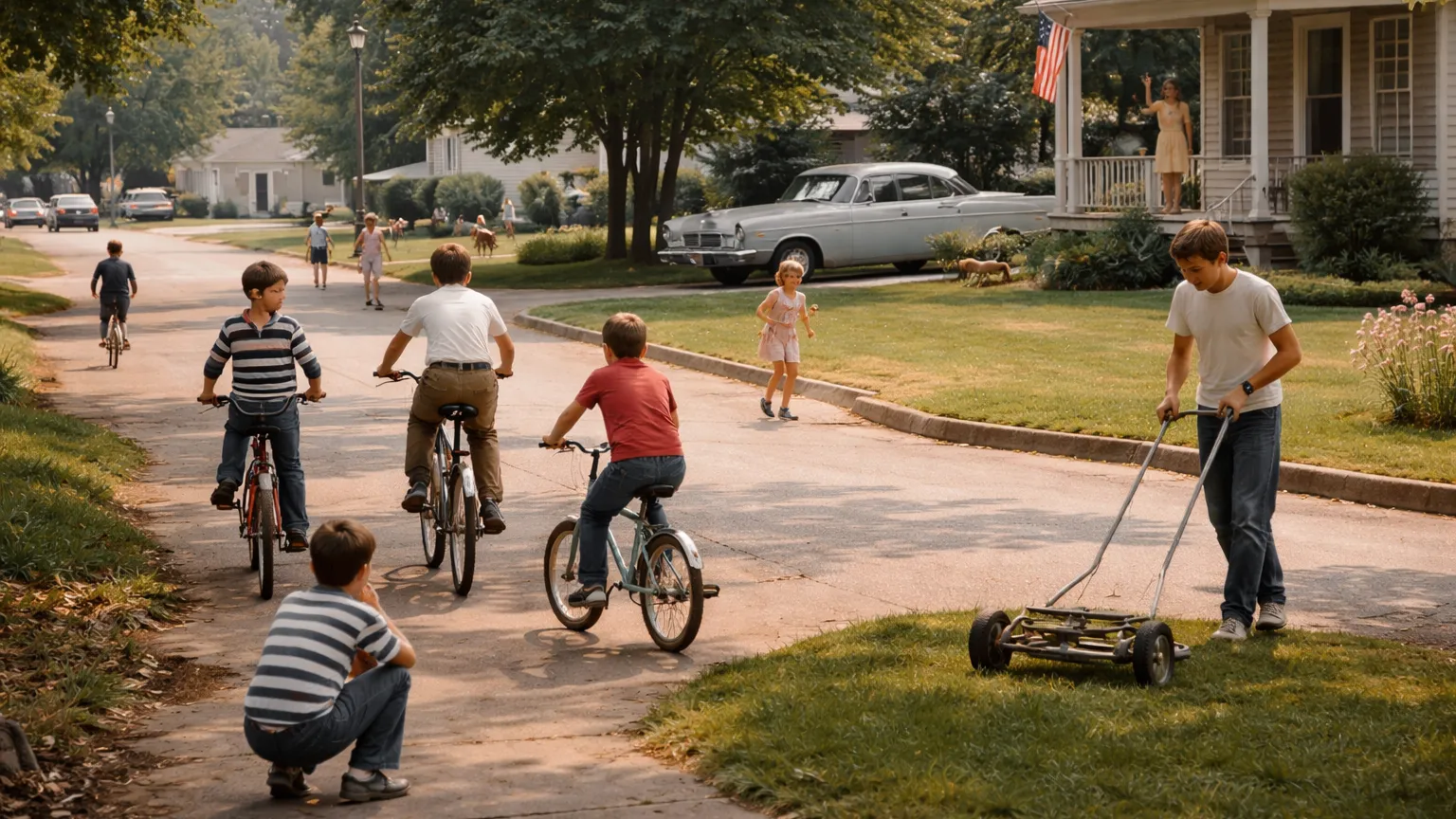
Perhaps the most stark difference between a Baby Boomer upbringing and that of a Gen Z or Alpha child is the relationship with technology and physical space. Boomers were the last generation to grow up with minimal digital distractions. There were no screens in their pockets, no instant notifications, and often only three channels on a black-and-white television. This lack of digital noise forced a different kind of engagement with the physical world.
Childhood for a Boomer was largely defined by unsupervised neighborhood exploration. The common refrain was, “Be home when the streetlights come on.” This autonomy fostered a high degree of self-reliance and social problem-solving. Without a GPS or a cell phone to call for help, Boomers learned to navigate physical geography and social hierarchies on their own. This “free-range” lifestyle is the source of the Boomer pride in “figuring it out,” though it also created a generational gap in how they perceive safety and supervision today.
Discipline, Authority, and the School of Hard Knocks
The educational environment of the 1950s and 60s was a far cry from the collaborative, student-centered classrooms of today. It was a time of strict hierarchical discipline. Teachers were figures of absolute authority, and the “three Rs” (Reading, Writing, and Arithmetic) were delivered with a side of rigid behavioral expectations. In many cases, physical discipline was not just accepted but expected.
This environment taught Boomers to respect—and sometimes fear—authority figures and established hierarchies. It reinforced the idea that success is earned through endurance and compliance. While this led to a generation of disciplined workers, it also explains the friction often felt in modern, “flat” corporate structures. To a Boomer, a boss is a boss; to a Millennial, a boss is a collaborator. This difference in perspective is a direct byproduct of the classroom settings where they spent their youth.
Living Under the Shadow of the Cold War
While the domestic front was stable, the global stage was fraught with tension. A significant part of the Baby Boomer upbringing involved growing up during the height of the Cold War. “Duck and cover” drills in schools were a regular reminder that the world could end at any moment. This geopolitical backdrop created a unique psychological cocktail: a drive to live life to the fullest in the present, coupled with a lingering sense of existential anxiety.
This era also emphasized a clear “Us vs. Them” mentality, which translated into a fierce sense of patriotism and community social cohesion. When there is a perceived external threat, internal bonds often tighten. Boomers grew up in communities that felt more interconnected because they felt they were all on the same side of a global struggle. This fostered a deep value for community organizations, lodges, and local clubs—entities that have seen a decline in subsequent, more globalized generations.
The Scarcity Mindset in an Age of Plenty
Even though the economy was booming, the memory of the Great Depression lived on through the Boomers’ parents. This scarcity-driven financial mindset was passed down like an heirloom during a typical Baby Boomer upbringing. Boomers were taught the value of a dollar, the importance of manual labor, and the virtue of saving. It was common for teenagers to take on manual labor jobs early—delivering newspapers or working in factories—not just for extra cash, but as a rite of passage into adulthood.
This relationship with work was transactional and dutiful. You worked hard because that was your contribution to society and your family. The idea of “finding your passion” or “work-life balance” was a luxury that didn’t exist in the Boomer vocabulary of the 1950s. This is why many Boomers are perplexed by the modern emphasis on mental health in the workplace; they were raised to believe that the work itself was the reward, regardless of the emotional toll.
Navigating the Slow Speed of Information
In our world of 5G and instant search results, it’s hard to imagine the limited information access Boomers dealt with. If you wanted to know something, you went to the library and consulted an encyclopedia that might be five years out of date. If you wanted to see a friend, you rode your bike to their house to see if they were home.
This “slow” information cycle forced a different kind of patience and a higher value on verified expertise. It also meant that social circles were smaller and more localized. Cultural trends took months to travel from the coast to the Midwest. This fostered a sense of regional identity and a slower pace of social change, which contrasts sharply with the rapid-fire cultural shifts we experience today through social media.
Bridging the Generational Gap
If you are looking to better understand the Boomers in your life, or a Boomer looking to reflect on your own journey, keep these practical points in mind:
-
Acknowledge the Context: Recognize that Boomer “toughness” often comes from a lack of emotional support systems that we take for granted today. Their resilience was a survival mechanism.
-
Value the Offline Skills: There is immense wisdom in the Boomer ability to navigate the physical world, read people face-to-face, and fix things with their hands.
-
Validate the Shift: For someone raised in a world of high institutional trust, the modern era of misinformation can be deeply jarring. Have empathy for that transition.
-
Focus on Shared Values: Behind the different “hows” of our generations, the “whys”—family, security, and purpose—remain largely the same.
The Legacy of the Baby Boomer Upbringing
The Baby Boomer upbringing was a unique intersection of prosperity and pressure. It produced a generation that is fiercely independent yet deeply respectful of order; financially savvy yet driven by a history of scarcity; and profoundly community-oriented yet often skeptical of rapid social change. Their childhood was the “Great Compression” of traditional values meeting the modern world.
As we move further into the 21st century, the influence of these formative years doesn’t disappear; it evolves. By understanding the environment that built the Boomer perspective, we move away from judgment and toward a more nuanced, empathetic dialogue. After all, every generation is simply a product of the world they were given, trying their best to build a better one for the generation that follows.