






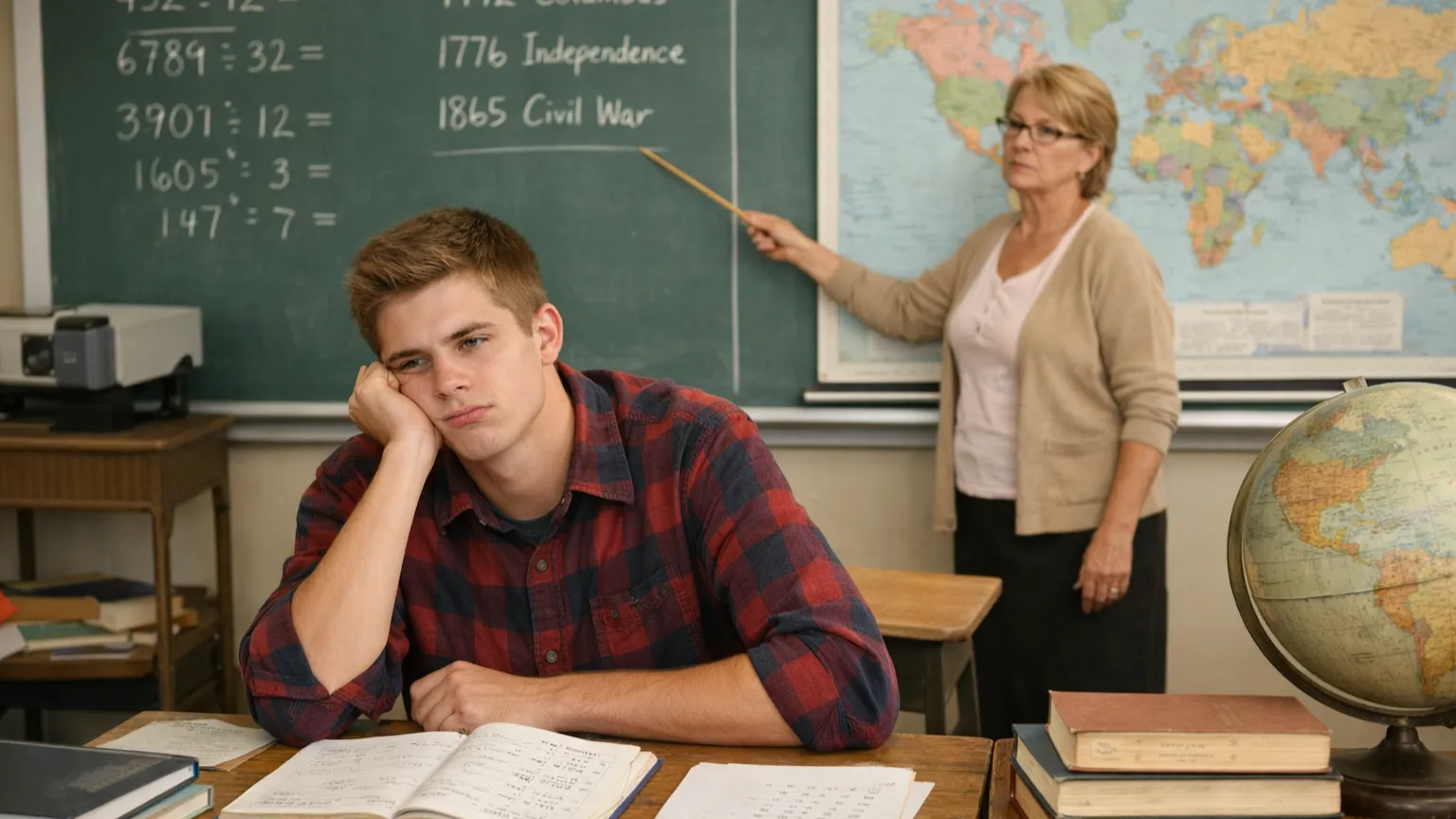
Walk into a modern office today, and you’ll see people collaborating across time zones, leveraging artificial intelligence to solve complex logistics, and pivoting strategies based on real-time data. Now, walk into the average classroom. You’ll likely find rows of desks, a teacher at the front, and students memorizing outdated school subjects and facts that a smartphone could provide in half a second. While the world has undergone a radical transformation, our educational foundations are often anchored in the industrial era. This gap isn’t just a matter of “old vs. new”; it is a fundamental mismatch that can actually hinder how a young brain learns to process information. By sticking to a script written decades ago, we risk stifling the very cognitive flexibility and creativity that the future demands.
Defining the Walls of the Traditional Classroom
The traditional educational model was designed for a different species of economy. It was built to create reliable workers for factories and bureaucratic systems where following instructions was the highest virtue. This led to a rigid teaching structure where the teacher is the sole source of truth and the student is a passive vessel. In this environment, the “what” of learning is prioritized over the “how.”
We often see this manifest as rote memorization over logical application. When a curriculum demands that a student memorize a list of chemical elements without ever understanding how those elements interact in a real-world lab, it treats the brain like a hard drive rather than a processor. This lack of digital and practical integration creates a “static” learning environment. It’s a bubble where information exists in a vacuum, disconnected from the messy, non-linear reality of the modern professional world.
Why Certain Outdated School Subjects Hinder Modern Thinking
It sounds counterintuitive to suggest that education could hinder thinking, but the “linear processing” encouraged by old-school curricula can be a trap. Modern life is web-like; problems are interconnected and multifaceted. However, many outdated school subjects often teach students to look for the “one right answer” at the back of the textbook. This discourages critical questioning and makes students uncomfortable with ambiguity—the very space where innovation happens.
When theory is constantly prioritized over practice, the brain’s ability to solve problems creatively begins to atrophy. If a student is only rewarded for conformity—coloring within the lines and repeating the teacher’s words—they learn that “being right” is safer than “being bold.” This psychological conditioning makes it difficult for adults to break away from traditional paths, leading to a workforce that is excellent at following orders but struggles to lead through uncertainty.
Identifying the Subjects Falling Behind the Times
Not all subjects are created equal in the 21st century. Some pillars of education have simply lost their practical edge. Take manual long-form arithmetic, for example. While understanding the logic of numbers is vital, spending weeks mastering complex long division by hand, without ever touching a spreadsheet or a calculator, feels like teaching a pilot how to flap their arms instead of how to fly a plane.
Similarly, the heavy emphasis on historical date memorization is a relic of a time when information was scarce. Knowing that a battle happened in 1066 is far less important than understanding the socio-economic pressures that led to it. We also see this with physical shorthand or cursive requirements; while they are fine hobbies, they occupy valuable cognitive “real estate” that could be used for coding or digital literacy. Even geography is often taught through static maps and state capitals, ignoring the dynamic shifts in global geopolitics and climate change.
The Hidden Cost of Outdated School Subjects on Career Readiness
The most visible symptom of an outdated curriculum is the “skills gap.” Employers frequently complain that new graduates arrive with high GPAs but low adaptability. Because the classroom didn’t require them to pivot when a project failed, they struggle with the trial-and-error nature of modern startups or creative agencies.
Furthermore, the focus on individual testing over group work has led to a deficiency in collaborative abilities and emotional intelligence. In a world where your “soft skills” are often more valuable than your “hard skills,” a curriculum that ignores empathy, negotiation, and self-awareness leaves students academically over-qualified but professionally under-prepared. They might know the Pythagorean theorem, but they don’t know how to handle a difficult conversation with a teammate or manage their own mental health under pressure.
Shifting Toward a Modern Mindset
To fix this, we don’t necessarily need to throw away every textbook, but we do need to change the delivery. Shifting toward project-based learning allows students to see the immediate application of their knowledge. Instead of a test on physics, have them build a bridge; instead of an essay on history, have them create a documentary. This forces the brain to synthesize information rather than just store it.
We also need to prioritize data literacy and interdisciplinary studies. The boundaries between “science” and “art” are blurring. A modern graphic designer needs to understand the psychology of color, and a data scientist needs to be an effective storyteller. By valuing failure as a necessary step in growth—much like the “beta testing” phase in tech—we can encourage students to take risks. Integrating ethical AI usage into the classroom is also no longer optional; students must learn to use these tools as “co-pilots” for their creativity.
Essential Components of a Future-Proof Education
If we were to rebuild a curriculum from scratch today, it would look less like a list of outdated school subjects and more like a toolkit for life. Here are the pillars that truly support modern cognitive development:
| Core Pillar | Description |
| Critical Thinking | Learning how to spot bias, evaluate sources, and build logical arguments. |
| Financial Literacy | Understanding debt, investing, and the digital economy. |
| Digital Fluency | Cybersecurity, digital etiquette, and virtual collaboration. |
| Mental Resilience | Tools to manage stress and understand cognitive patterns. |
A New Path Forward
The goal of education should not be to fill a bucket, but to light a fire. By clinging to outdated school subjects and rigid methodologies, we are effectively asking our youth to run a marathon while wearing lead boots. The transition to a more fluid, practical, and cognitively stimulating curriculum isn’t just an “educational trend”—it’s a necessity for survival in a complex world.
We must advocate for schools that prioritize the “human” elements of intelligence: curiosity, empathy, and critical thought. If we can break the mold of the 19th-century classroom, we can unlock the true potential of the 21st-century mind.






No Response