There is a common misconception that our bodies have an “expiration date” for movement. We often hear friends or colleagues joke that once you hit 40, every morning starts with a new mysterious ache or a groan while reaching for the bottom shelf. While it is true that collagen production slows down and joints can lose their natural lubrication as we age, stiffness doesn’t have to be your new normal. Yoga for flexibility after 40 isn’t about twisting yourself into a human pretzel or chasing an aesthetic; it’s about reclaiming the range of motion that allows you to live life without restriction. Whether you want to keep up with your kids, excel at your favorite sport, or simply wake up feeling fluid rather than fragile, yoga offers a sustainable path to physical longevity. In this guide, we will explore why the 40s are the perfect time to start and which specific movements will offer the greatest return on your investment of time.
The Changing Landscape of the 40+ Body
Entering your 40s marks a significant physiological shift. This is the decade where we begin to notice the cumulative effects of years spent sitting at desks, carrying heavy bags, or perhaps neglecting a consistent stretching routine. For many, bone density begins to subtly decline, and the connective tissues—the fascia that holds everything together—can become “gluey” and restrictive.
Yoga acts as a mechanical tune-up for these systems. By engaging in weight-bearing poses, you aren’t just stretching muscles; you are stimulating bone growth and improving joint health. Beyond the physical, the 40s are often a high-stress decade, sandwiched between career peaks and family responsibilities. Practicing yoga for flexibility after 40 serves as a bridge, connecting the physical need for mobility with the mental need for a “reset” button. The benefits go far beyond touching your toes; they include improved circulation, better posture, and a nervous system that knows how to switch from “fight or flight” to “rest and digest.”
Laying the Foundation: Safety and Mindset
Before you unroll your mat, it is vital to shift your mindset from competition to connection. In our 20s, we might have pushed through pain to achieve a certain look. In our 40s, the goal is injury prevention and longevity. This means listening to the subtle whispers of your body before they become screams.
Safety starts with a proper warm-up; never jump into deep stretches with “cold” muscles. Think of your muscles like a rubber band: if you pull a frozen rubber band, it snaps. If you warm it up, it stretches. Additionally, don’t be afraid to use props. Blocks, straps, and even a sturdy chair aren’t “cheating”—they are tools that bring the floor to you, ensuring you maintain proper alignment without straining. Most importantly, remember that yoga happens in the breath. If you are holding your breath, your muscles will reflexively tighten to protect themselves, defeating the purpose of the practice.
Essential Poses for Total Body Renewal
The following seven poses are selected specifically for the 40+ demographic, focusing on the areas that tend to tighten the most: the hips, spine, and shoulders. These movements form the core of an effective routine of yoga for flexibility after 40.
1. Mountain Pose (Tadasana): The Blueprint of Alignment
It may look like you are just standing there, but Tadasana is the most important pose in your repertoire. As we age, gravity and habit tend to pull our shoulders forward and our heads down. Mountain Pose teaches us how to find our center again. By grounding through all four corners of your feet and engaging your thighs, you realign your spinal column. It creates a “body awareness” that carries over into your daily life, helping you stand taller and move with more confidence.
2. Cat-Cow Stretch: Restoring Spinal Fluidity
The spine is the highway of the nervous system, and in our 40s, that highway can get a bit congested. The rhythmic flow between Cat and Cow poses—arching and rounding the back—massages the discs between your vertebrae and encourages the flow of synovial fluid. This is often the “ah-ha” movement for people suffering from chronic lower back tension. It coordinates your breath with your movement, which is the secret sauce to calming a stressed-out mind.
3. Downward-Facing Dog: The Full-Body Reset
This is the quintessential yoga pose for a reason. Downward-Facing Dog offers a deep stretch for the hamstrings and calves, which often tighten from years of walking or wearing heeled shoes. Simultaneously, it builds upper body strength and helps decompress the spine by using gravity to pull the vertebrae apart. If your hamstrings feel tight, keep a generous bend in your knees; the goal is a long, straight back, not necessarily flat heels on the floor.
4. Warrior II: Power and Hip Opening
Mobility in the hips is closely linked to lower back health. Warrior II is a powerhouse pose that opens the hips and chest while building significant endurance in the legs. For those in their 40s, maintaining leg strength is crucial for balance and joint stability. As you hold this pose, you are also practicing “drishti” or focused gaze, which sharpens mental clarity and stability.
5. Tree Pose: Finding Your Center
Balance is a “use it or lose it” skill. Tree Pose challenges your neuromuscular coordination by forcing the small stabilizer muscles in your ankles and feet to work overtime. It also requires a subtle engagement of the pelvic floor and core. If you feel wobbly, keep your toes on the floor like a kickstand or place a hand on a wall. The goal is to find stillness amidst the sway.
6. Sphinx Pose: A Gentle Heart Opener
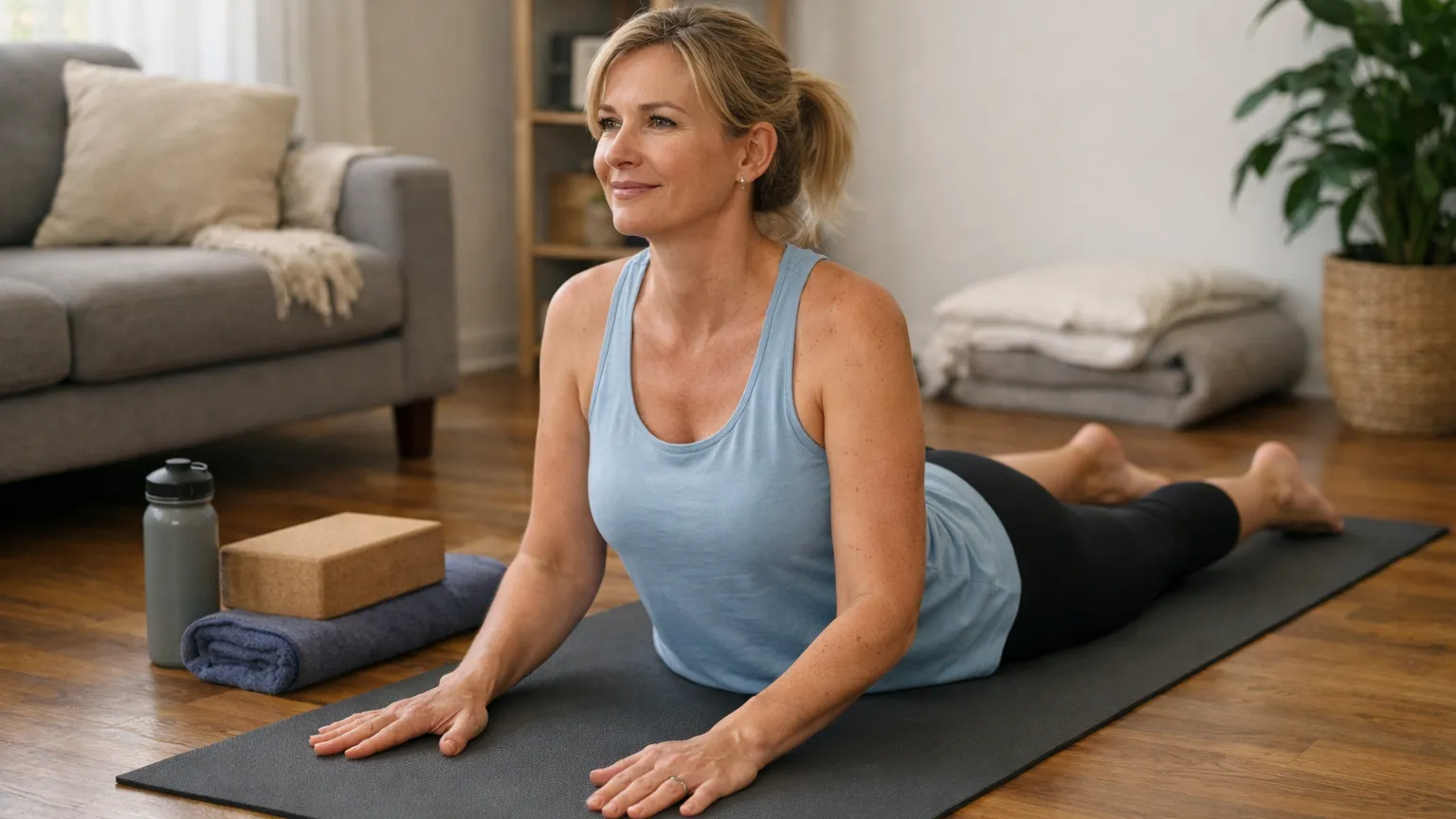
Many of us spend our days hunched over keyboards, leading to a “closed” chest and a rounded upper back. Sphinx Pose is a gentle, accessible backbend that counteracts this posture. By resting on your forearms and lifting your chest, you stimulate the abdominal organs and provide a mild, therapeutic stretch to the lower back. It is the perfect antidote to the “tech neck” that plagues the modern professional.
7. Child’s Pose: The Art of Letting Go
Every yoga practice should include a moment of surrender. Child’s Pose is a restorative sanctuary that allows the nervous system to settle. It provides a gentle stretch to the lower back and hips while giving the brain a break from external stimuli. Think of it as a “reset” button for your stress levels—a place to return to whenever the world feels a bit too heavy.
Cultivating a Sustainable Practice
Consistency will always trump intensity. You don’t need to spend ninety minutes on the mat every day to see results. In fact, practicing yoga for flexibility after 40 for fifteen to twenty minutes three times a week is often more effective for long-term mobility than one long session once a month.
Hydration is also a key factor that many overlook. Your fascia—the connective tissue mentioned earlier—needs water to stay supple. Drinking plenty of water before and after your sessions will help your tissues glide more easily. Finally, celebrate the small wins. Maybe today you reached an inch further, or perhaps you simply noticed you didn’t hold your breath when things got challenging. Yoga is a journey of millimeters, not miles.
Embracing the Journey Ahead
Your 40s are not the beginning of the end; they are the start of a more mindful and intentional relationship with your body. By integrating these seven yoga poses into your routine, you aren’t just working on your flexibility; you are investing in a future where you move with ease, grace, and strength.
The stiffness you feel today doesn’t have to be a permanent resident. With a little patience, a few deep breaths, and a commitment to yoga for flexibility after 40, you can unlock a level of mobility that makes your 40s—and the decades beyond—your most vibrant years yet.